person — data and AI
Zingaline
An installation: one visitor at a time, alone at a desk for six to nineteen minutes. You write down one thing you wish you could do over, and the page is shredded. A version of you made from those words takes a son’s place on the night before he leaves home. That night had been rehearsed 2,000 times before you came.
- Year
- 2026, June to October · four rounds, the direction changed twice
- Role
- Individual project. Story, stage, software, film and these pages; the questionnaire; the exhibition concept.
- Institution
- College of Design and Innovation, Tongji University
- Status
- Shown once, at a small show at the College of Design and Innovation, Tongji University, in September 2026; a dozen or so visitors tried it.
01Background · Research · Insight
When we make ourselves out of data, what is still worth keeping?
question 8 of my questionnaire 你最不想被预演的是什么 · “what would you least want rehearsed?” · 19 people, 14–20 September 2026, in their own words
- 01. 人生的轨迹和上限 the course of my life, and its ceiling
- 02. 出轨被发现 being found out cheating
- 03. 无 none
- 04. 死 death
- 05. 去世 dying
- 06. 最不想被预演旅行的风景 the scenery of a journey
- 07. 没有 nothing
- 08. 某个随机事件或者某次试验 a random event, or an experiment
- 09. 不清楚 not sure
- 10. 一部分是惊喜 一部分是预演出更好的结果但是我的现实生活没有实现的话会感觉很失望 surprises; and a better outcome in rehearsal that my real life then fails to reach
- 11. 珍惜的体验,比如和朋友的相遇 experiences I treasure, like meeting a friend
- 12. 重大决策中的不同选择是会导致人生道路从此南辕北辙还是最终收敛到同一结果 whether the different choices in a big decision send a life in opposite directions or end in the same place
- 13. 爱情和人生抉择 love, and the choices of a life
- 14. 我也不知道 I don’t know either
- 15. 感情 love
- 16. 未来会被局限在某一方面,或者量化某一件事的可能性 a future narrowed to one side, or a possibility turned into a number
- 17. 说不清 hard to say
- 18. 任何感情方面的经历 anything I go through in love
- 19. 和亲近的人分别 parting from someone close
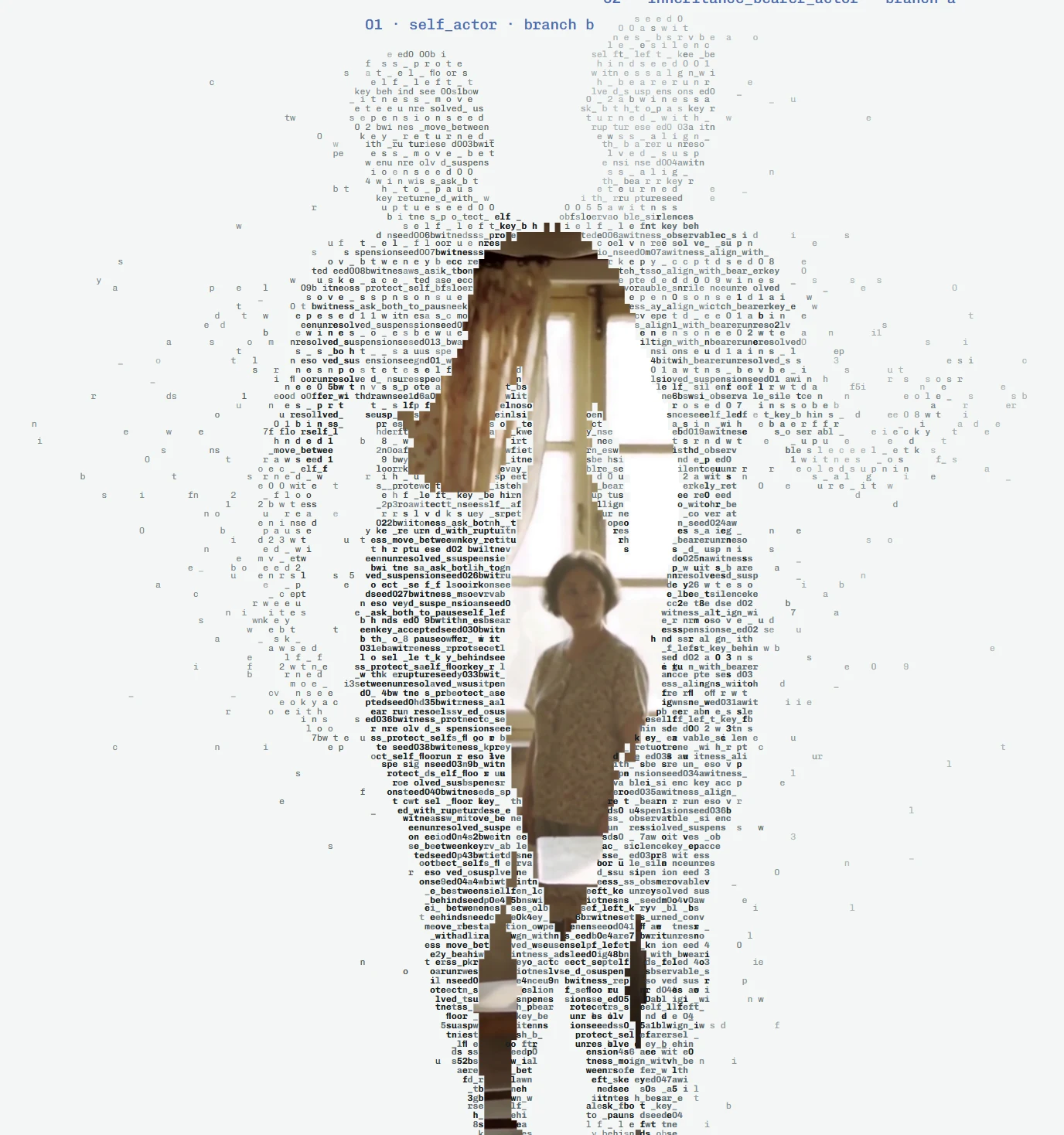
how to read this page
- 人生的轨迹和上限Highlighted: people’s own words: the 19 respondents’, my friends’, mine.
- seed 000 a witness…Blue: what the machine makes, its records, commands and code.
- A person printed in characters: a figure filled with words or records.
- Dashed: destroyed, like the shredded page.
Background
In an age of highly developed social networks and technology, people have become more atomised than ever. It is as if everyone had come down with loneliness, like an illness, one that has to be treated by rehearsing again and again; and AI, as the embodiment of big data, gives people endless chances to rehearse their own lives.
1.Where it came from: a conversation that hasn’t happened yet
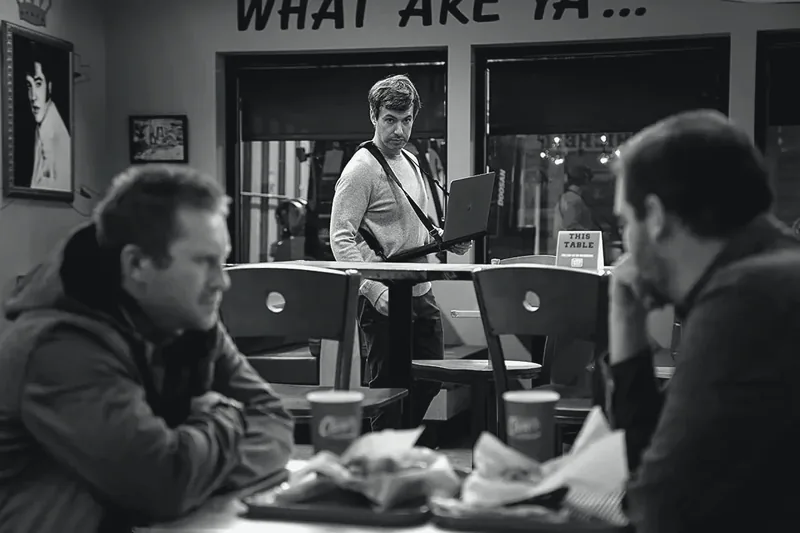
My parents want me to rent a place near them; I want to go out and make my own way. This conversation hasn’t happened yet, and I want to rehearse it first.
The idea came from Nathan Fielder’s docu-comedy The Rehearsal (HBO, 2022), in which he helps ordinary people rehearse the big moments of their lives with realistic sets and scripts.
2.The more connected, the more isolated
- 1 / 6people worldwide are affected by lonelinessWorld Health Organization 2025
- 64.2%of young people surveyed feel they freeze up socially; 40.3% avoid socialisingChina Youth Daily Social Survey Center 2023 · 2,001 people aged 18–35
- nearbyXiang Biao’s “disappearance of the nearby”: people have lost the wish, and the ability, to step into the world around them and make sense of itXiang Biao, China News Service 2026
3.Where rehearsal is taken seriously
Autistic people often rehearse situations ahead of time, again and again, to cope with social life that is hard to predict (May, 2022). After the series aired, many autistic viewers said its rehearsals looked like their own daily life (BuzzFeed 2022; OAR 2025).
- social scriptsautism supportBellinger et al. 2011
- behavioural rehearsalcognitive behavioural therapyCartledge 2007
- a realistic setThe RehearsalHBO 2022
- rehearsing a conversation with AI10 of the 19 I askedmy questionnaire
- your data versionZingalinethis work
people rehearsedata rehearses
User research
1.A group portrait: people who rehearse with AI, and use it to look after themselves
US teenagers
72%have used an AI companionCommon Sense Media 2025US adults
10%use chatbots for emotional supportPew Research Center 2026AI-companion users
53%ask AI how to get along with other peopleElon University Poll 2026the 19 people I asked
10 / 19rehearsed a real conversation with AI or a tool in the past yearmy questionnaire 2026
The four figures come from different groups of people, so they stand side by side and are never added up.
2.The questionnaire: 19 people, one line each
From 14 to 20 September 2026 I asked 19 people around me: if you could run a decision in your life many times to see the different outcomes, would you? Each line is one person, from what they would run again (left), through four questions, to what they would least want rehearsed (right); the seven highlighted lines are the people who chose both.
# survey.json · 19 rows · keys drawn: rerun q1 q2 reactions q7 never
Insight
Data turns “possible” into “probable”, and what people least want rehearsed are the moments that happen only once.
Two more: the more connected people are, the more isolated they become, and the social moments nobody has rehearsed are handed to AI to practise (see Background); and AI rehearsal can comfort people, but it can also replace people: those who chose to chat more with chatbots were lonelier and saw real people less (MIT and OpenAI 2025, 981 people, 4 weeks; a correlation only).
3.Data can already rebuild a person
- 1,052US adults rebuilt as AI agents from two-hour interviewsPark et al. 2024, rev. 2026, preprint
- 1,000+dead relatives replicated by one Shanghai firmMIT Technology Review 2024
- $2BNvaluation of a firm that sells simulated usersTechCrunch 2026
4.Predicted by data, people are curious first
Question 6: from your data, the system says “you are 70% likely to leave”. Your first reaction? (more than one allowed; 19 people)
5.What people least want rehearsed
- 16a future narrowed to one side, or a possibility turned into a number
- 10surprises; and a better outcome in rehearsal that my real life then fails to reach
Question 8, “What would you least want rehearsed?”; the grouping is mine, from their own words.
02Define · Concept
The gap: between endless rehearsal and a real moment that happens only once
Define
1.One conversation’s journey: in real life, and in the rehearsal room
in real life
- 01Thinking of saying itan important conversation, not yet begunMe: the conversation with my parents is still stuck here
- 02Rehearsing it in my headagain and again
- 03Rehearsing with AI or someone10 of 19 did this in the past yearThe gap. The rehearsal room goes here.
- 04The real momentonly once
- 05Wanting to redo it13 of 19 would run a decision again many times
in the rehearsal room
- ihand overhandwritten page → reading → events
- iithe eveningevents → your data version
- iiiagain1,000 paired runs: 549 / 405
- ivmemory12 generated clips
- vlose controlall 2,000 replayed
- codaback to realitythe receipt: a record of this time↑ back to the real moment
Concept
To use what AI can do to build a rehearsal room that simulates real characters, settings and scenes as closely as possible, where people can rehearse, or re-enact, the important moments that have not happened yet or have already passed; to let them see countless virtual possibilities rehearsed from data; and to let them realise, in the end, that returning to what is real matters most.
- G1 simulate the real characters, settings and scenes as close to real as possible
- G2 rehearse / re-enact important moments yet to happen, or already past
- G3 countless possibilities see the virtual possibilities rehearsed from data
- G4 back to the real realise that returning to the real matters most
2.Jinjialin: a planet turned into four rules
Zingaline is my spelling of 津加林 (Jinjialin), the last planet in Hao Jingfang’s Invisible Planets. When two of its people walk past each other, their bodies overlap and exchange matter, and they part as two new people who believe they have not changed. In the work, the visitor’s words and the software’s records mix in one figure in the same way. The other source is Heraclitus: “You cannot step into the same river twice.” When the scene goes back in act iii, it fades out and starts again; the second time is not the same evening.
- Two bodies overlapAct i: your words and the machine’s records mix into one figure
- You cannot step into the same river twiceAct iii: the rewind only fades out and starts again; the second time is not the same evening
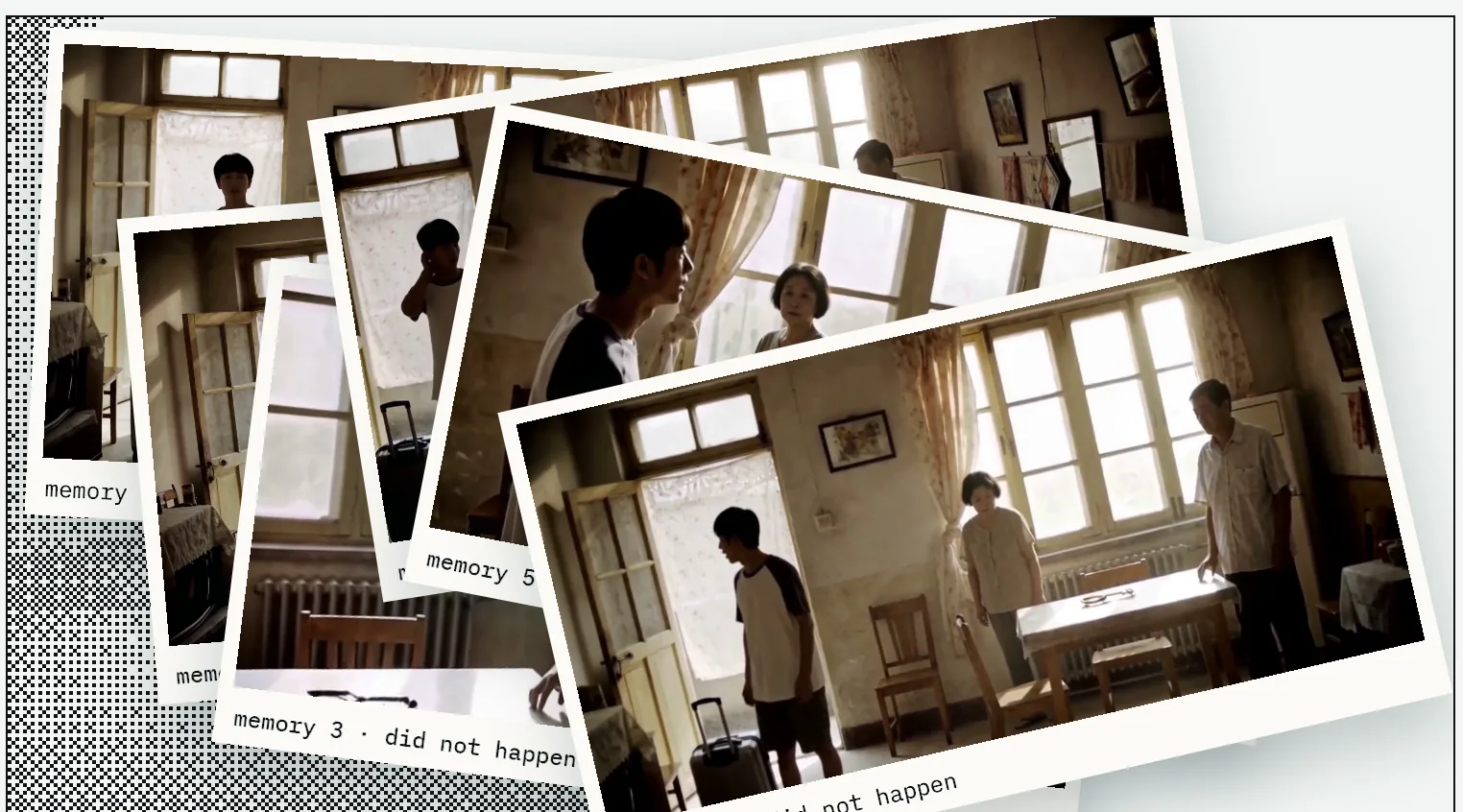
- Parted, they are new peopleAct iv: an evening that never happened becomes a memory
- The composite after the overlapAct v: the choice is no longer yours
3.Six books, six rules of the room
| Han | 2014 | → you hand the page over yourself | i |
| Bergson | 1889 | → time is shown as cut segments | ii |
| Rosa | 2018 | → the stage only plays recordings | ii |
| Arendt | 1958 | → the rewind never runs backwards | iii |
| Baudrillard | 1981 | → the home video exists before the evening | iv |
| Dunne & Raby | 2013 | → it ends on a question | coda |
Each book changed the rules of one act; on the right, the act it belongs to.
4.Position: how this differs from existing rehearsal
rehearsed by people
rehearsed by data
back to reality after rehearsing
staying in the simulation
03System · Iteration
Act i makes your data version; in acts ii to v it stands in for the son
The visitor sits alone at a desk for about 6 to 19 minutes.
System design
1.One visit: five acts, each handing over more
participant/src · handover.ts (i) · acts.ts (ii, iii, v) · tape.ts (iv) · replay.ts (v) · receipt.ts (coda) · the machine row: the app’s own commands
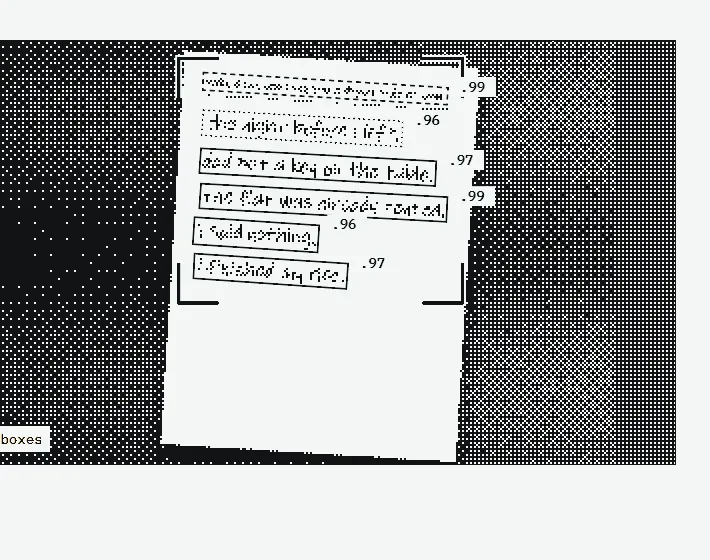
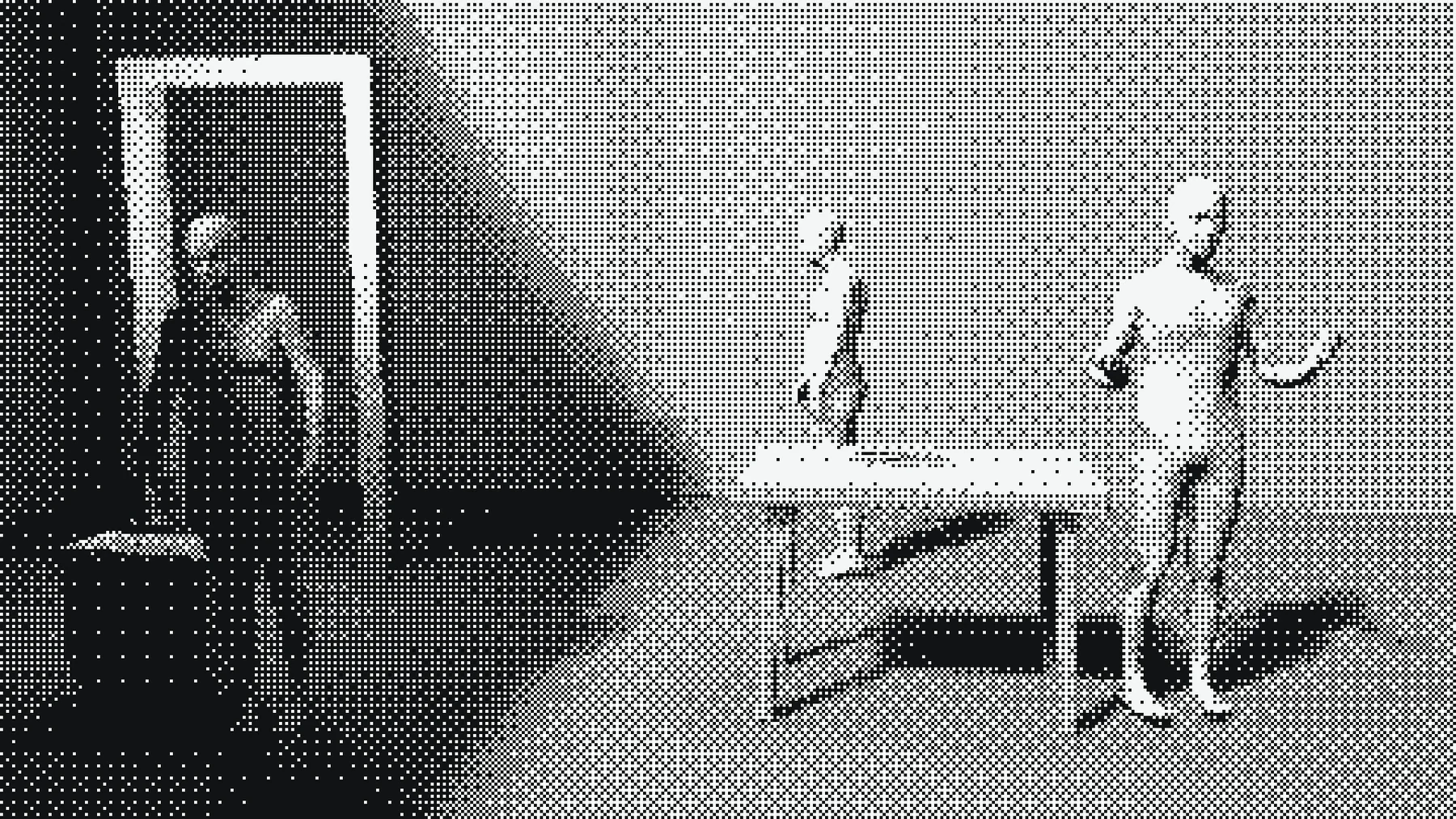
Six columns; swipe sideways to read every act.
2.Why this evening
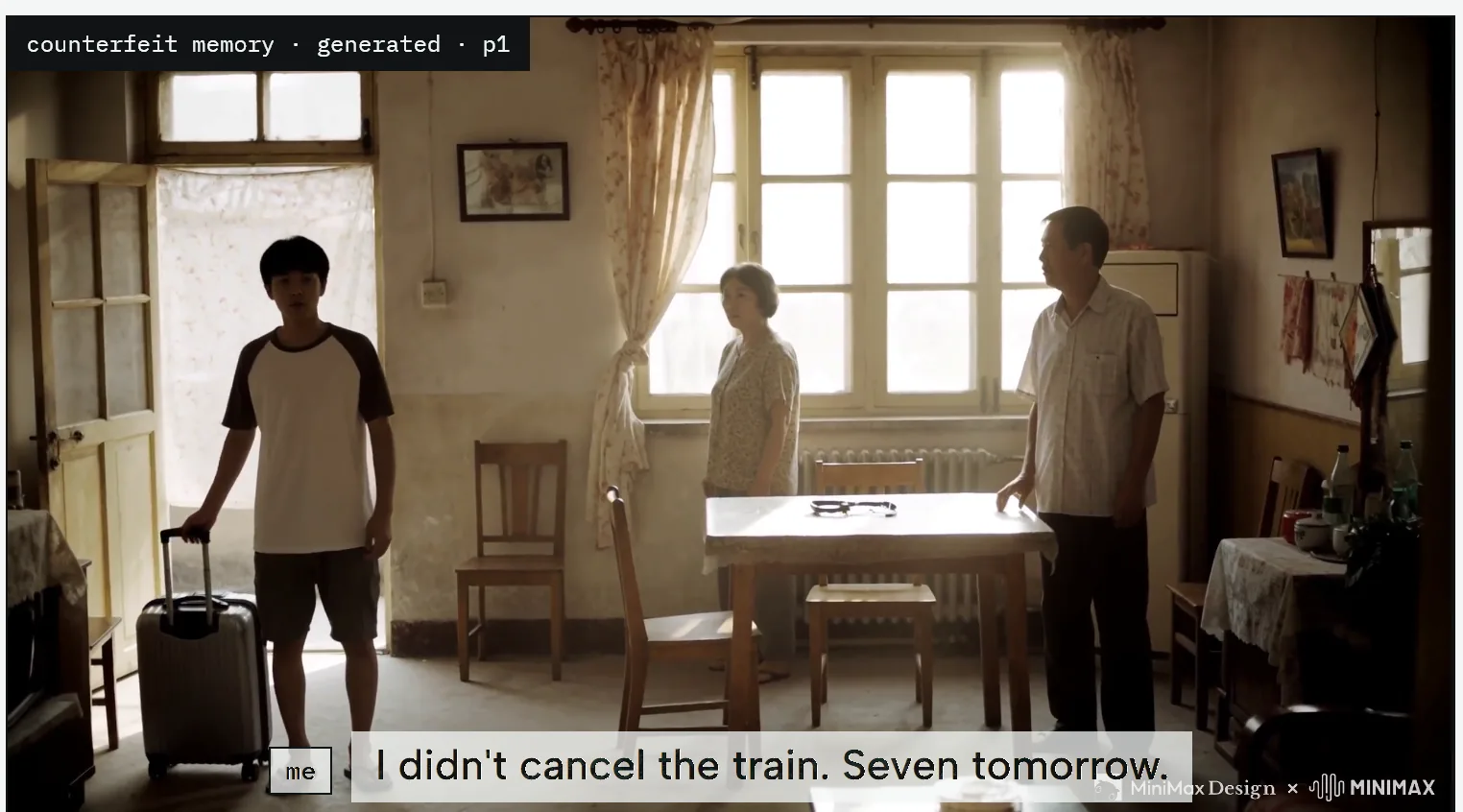
The scene comes from my own life: my parents want me to rent a place near them, and I want to go out and make my own way. The real conversation hasn’t happened yet, so I wrote it as one evening. It is also the kind of moment people in my questionnaire least wanted rehearsed, people and love; one of them wrote “parting from someone close”.
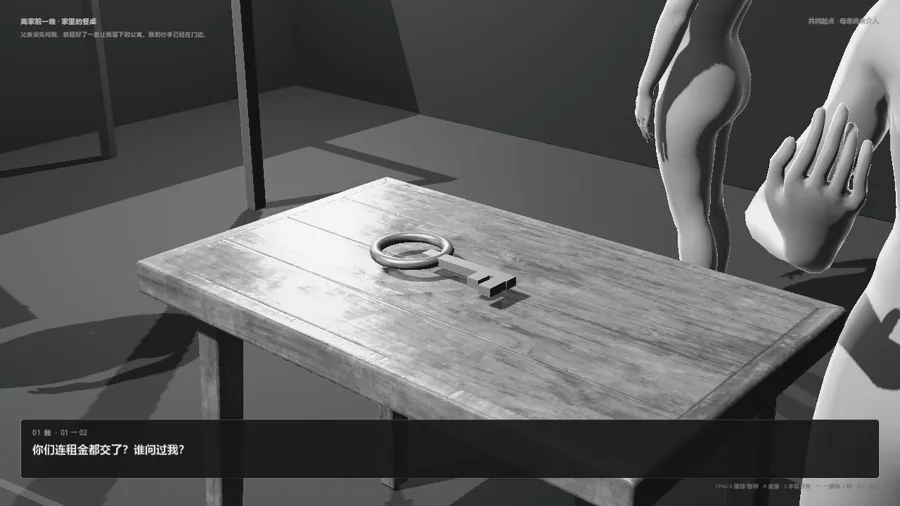
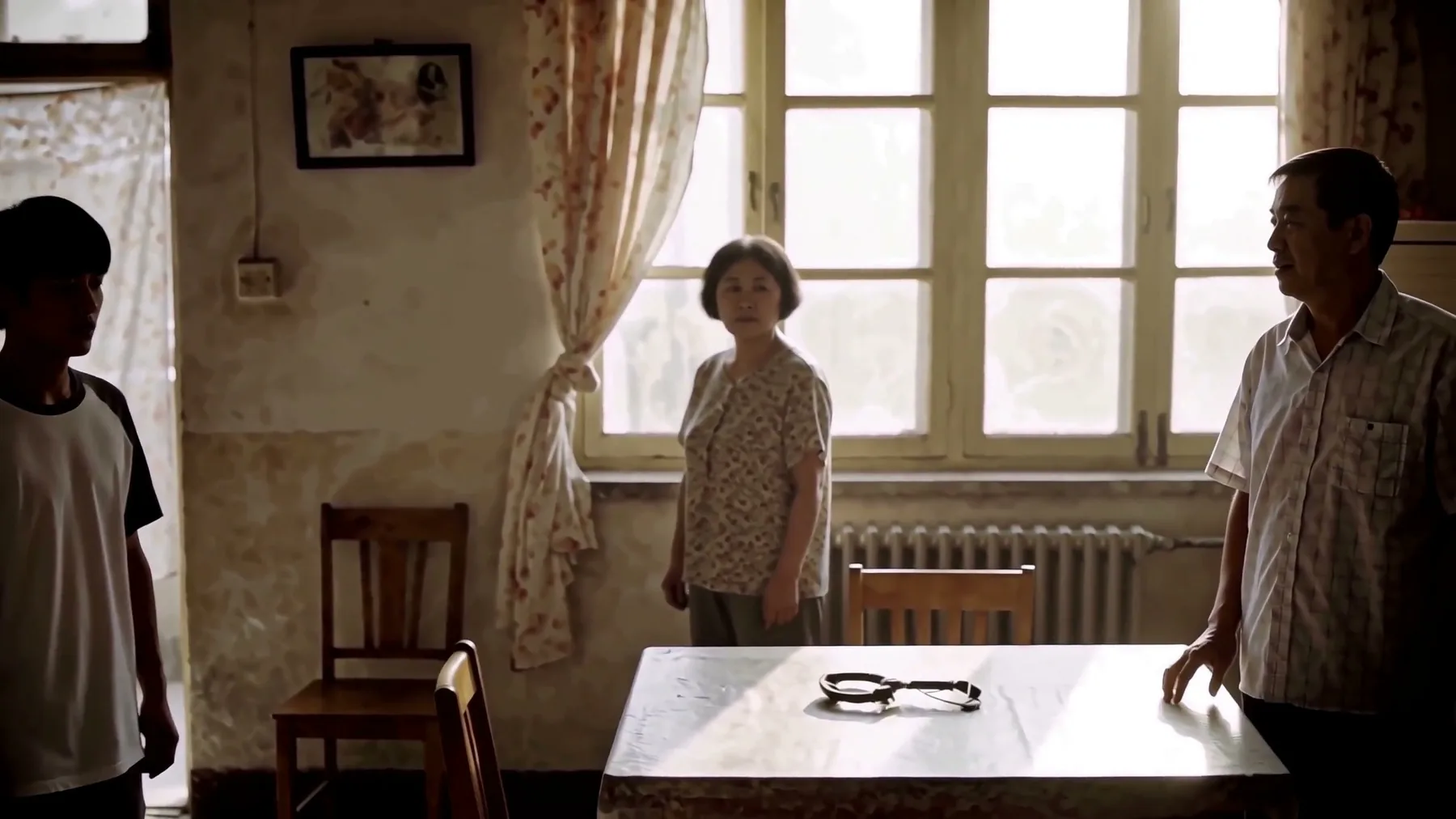
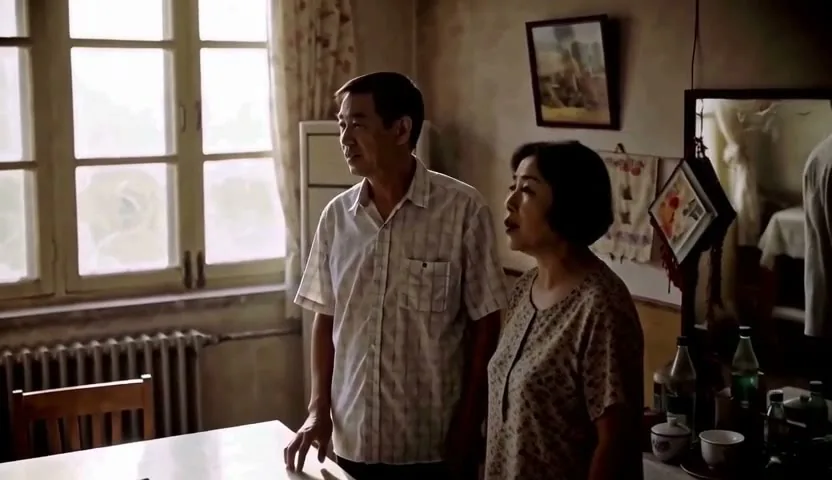
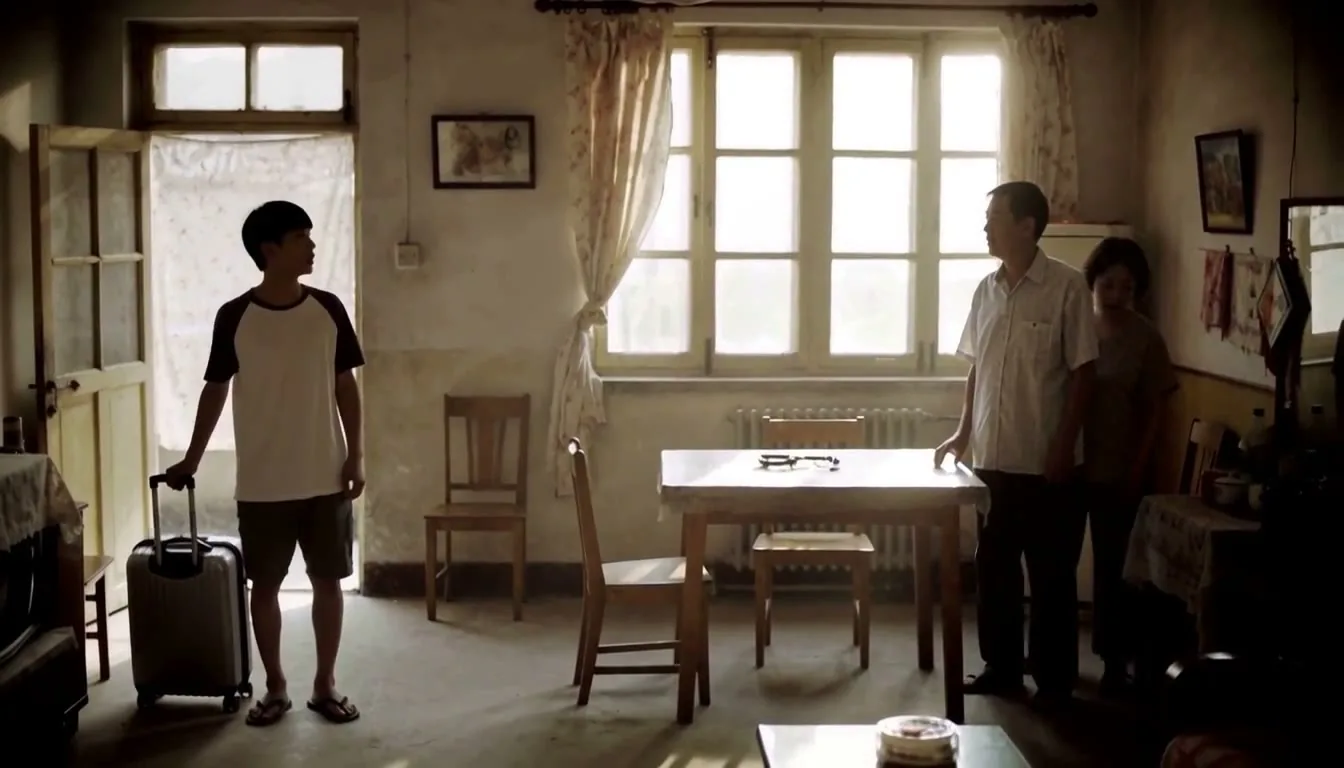
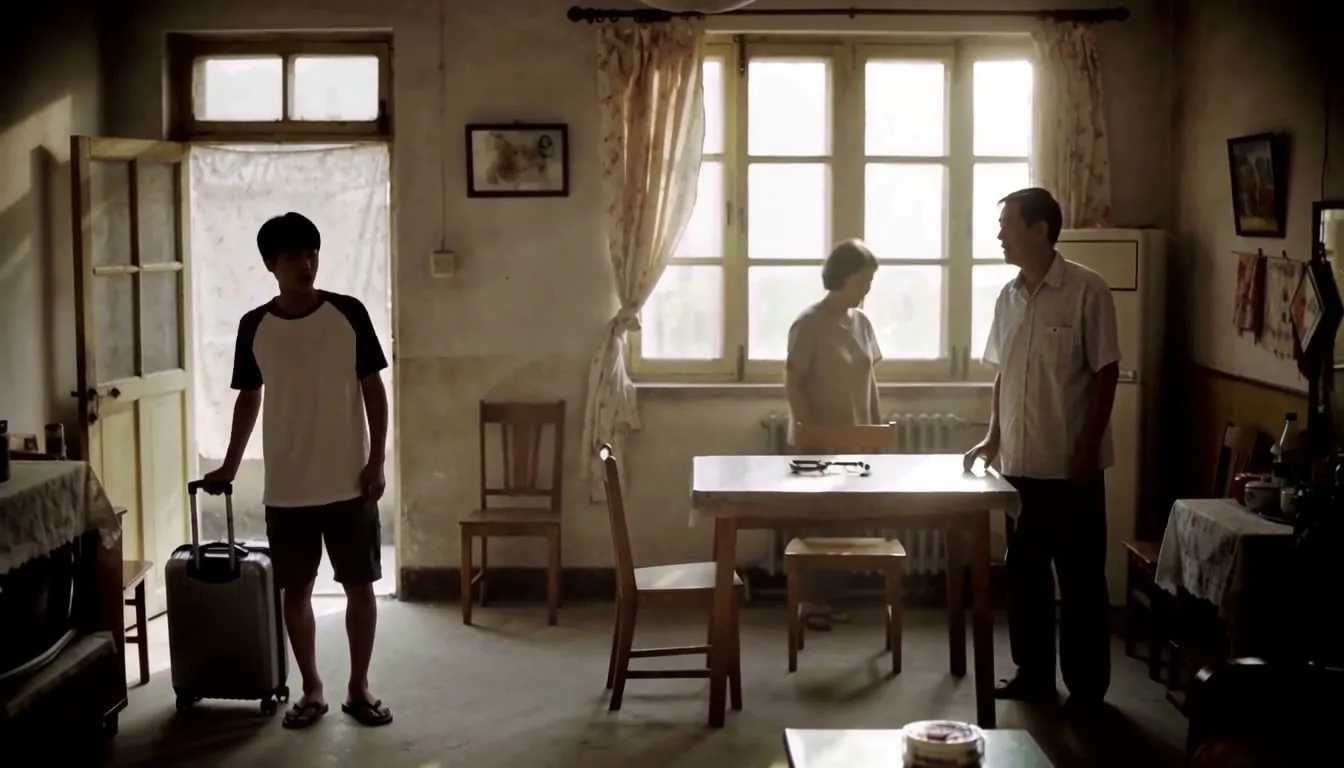
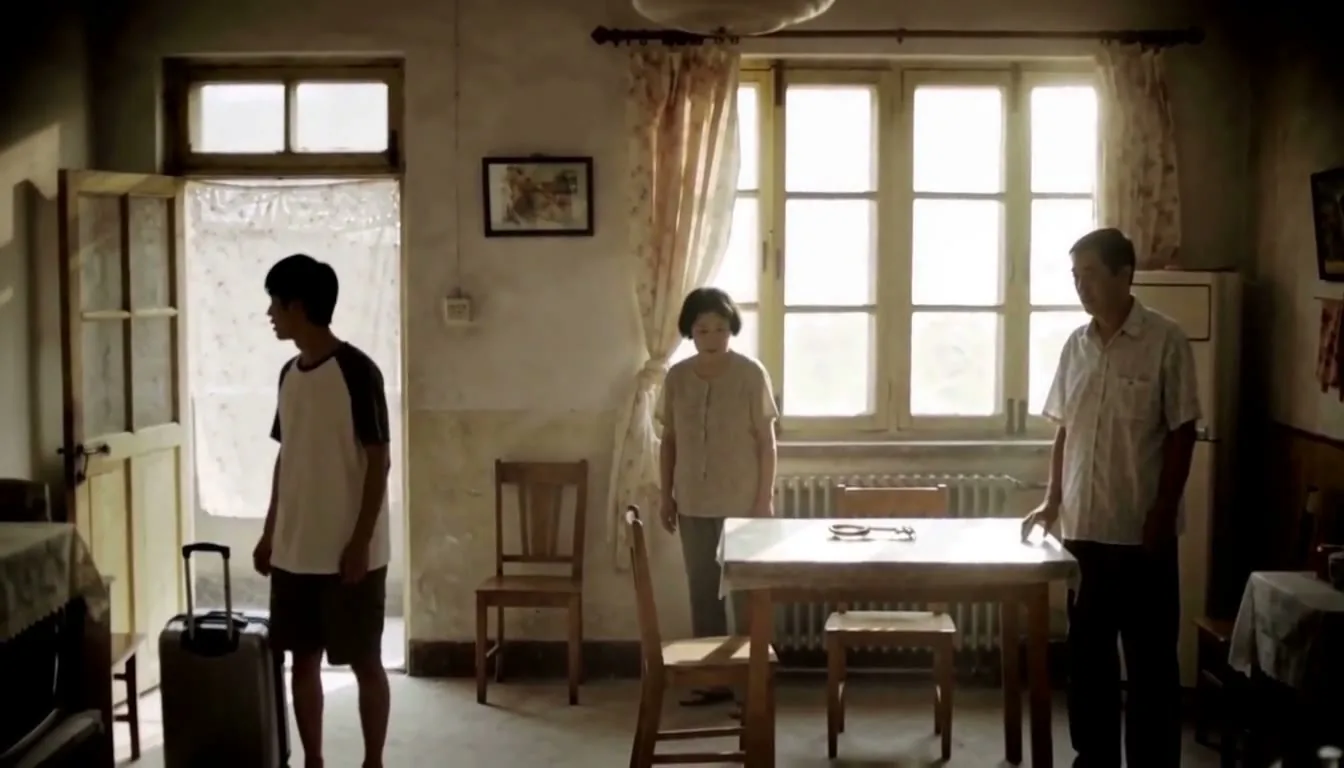
The parents spent two months finding a flat twenty minutes from the son’s work and have paid the rent; the key is on the table. The son is leaving tomorrow morning as planned, and does not take the key.
lines from act iv’s home video
- sonI didn’t cancel the train. Seven tomorrow.票我没退。明天早上七点的。
- fatherIt faces south. Twenty minutes from your office, you could cycle. Take the key for now.朝南的。离你公司二十分钟,骑车都行。钥匙先拿着。
- sonDad. I’ve already got a place there.爸……我那边已经租好了。
3.The room
All five acts happen at this desk; its letters match the “in the room” row above.
- One visitor at a time sits at the desk.
- The visitor holds the page up, flat, under the camera.
- Shredded pages fill a clear box in the corridor.
- The visitor sees the records wall only on the way out.
- The visitor leaves with the printed receipt.
In a full showing: one visitor at a time, the door closed; the next waits outside, watching a box of shredded pages fill up.
4.Your data version
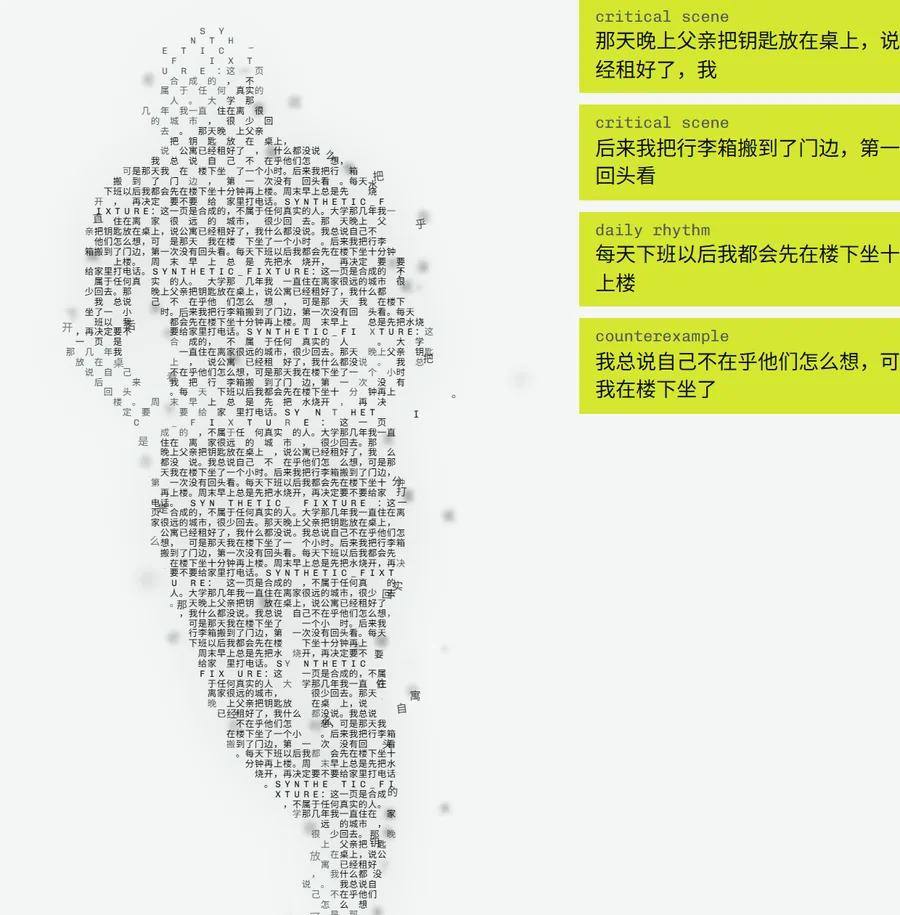
What the visitor sees at the end of act i: a figure printed in their own handwritten words, and the few events the machine picked out of them.
Iteration
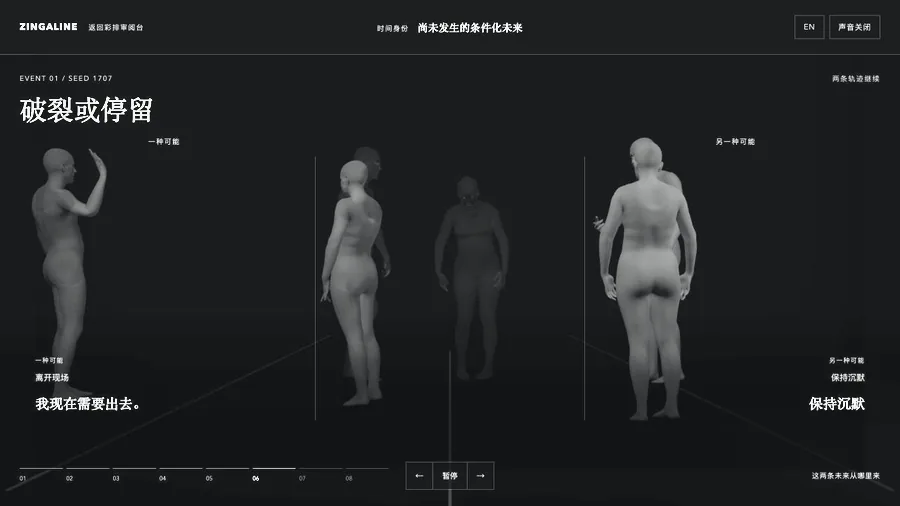
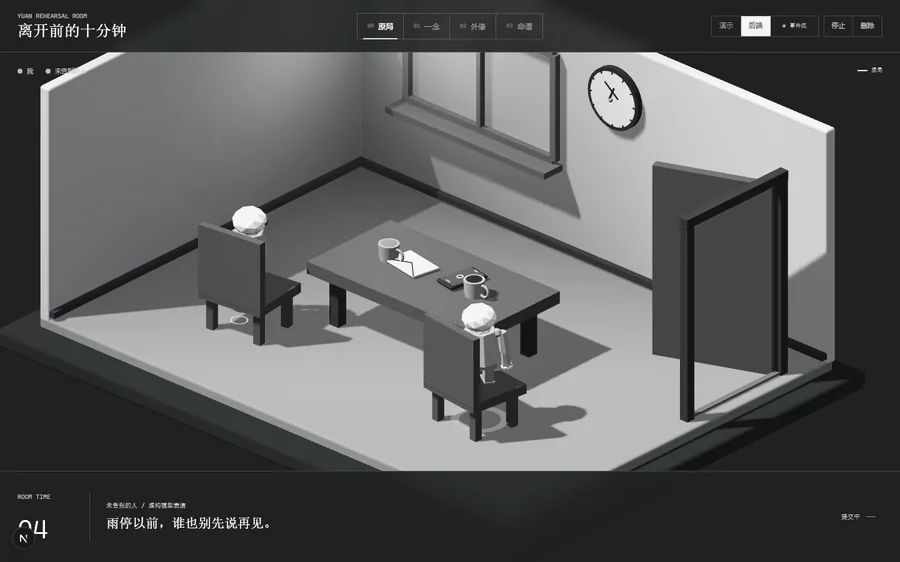
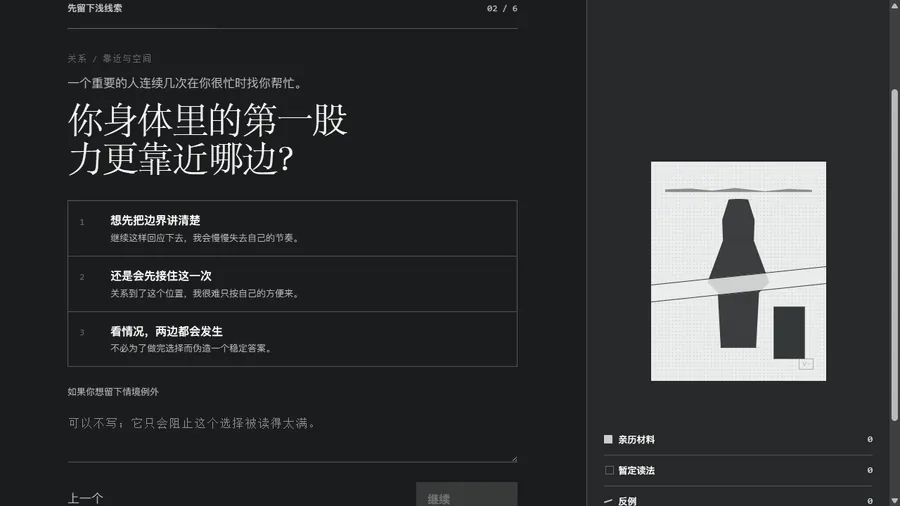
1.Four rounds; the direction changed twice
- 0 · research tooldropped
- 1 · encounter roomfrozen
- 2 · probable selvescarried on
- 3 · the roomnow
- 20.07first live scene
- 07.08one evening, two branches
- 13.09walkthrough · 10 findings
- 15.09the room, first build
- 17.09one ink
- 18.09the tape
- 23.09v4
- 24.09v5
2.Each round’s prototype
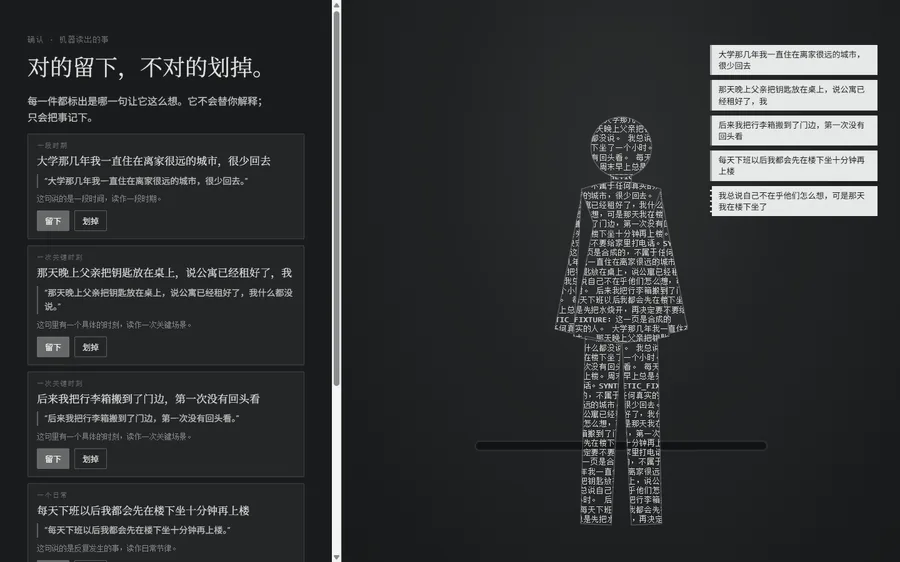
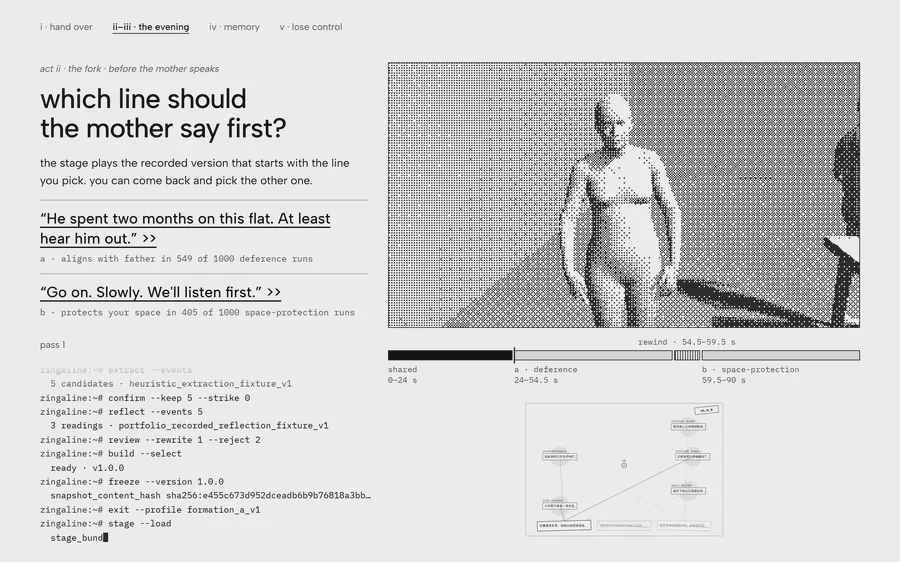
3.Four decisions: what was compared, and what was chosen
Ratings are from my design notes; the chosen row is black. ● yes · ◐ in part · ○ no · – not rated in the record.
the story which evening to rehearse · 14 Sep
| lure | fits thesis | 3 bodies, 1 table | no remake | |
|---|---|---|---|---|
| bringing a partner home | ||||
| the unsent message | ||||
| words at a hospital bed | ||||
| return the key |
each other story needs 3–4 weeks of new recording
handing over what visitors give · 14–15 Sep
| not a form | own words | given up | photographable | |
|---|---|---|---|---|
| six questions (August build) | ||||
| paste a text | ||||
| arrange five objects | ||||
| speak for a minute | ||||
| a handwritten page, then shredded |
the shredder is the one step that cannot be undone
the evening where the scene runs · 14–15 Sep
| picture | interaction | cost | |
|---|---|---|---|
| all in Godot | |||
| all in the browser (three.js) | |||
| all rendered in Blender | |||
| browser + Blender; Godot checks |
the browser is the only live runtime
the memory what the home video shows · 18–19 Sep
| just watched | from the rehearsal | passes the check | lines in place | |
|---|---|---|---|---|
| breakfast, the next day | ||||
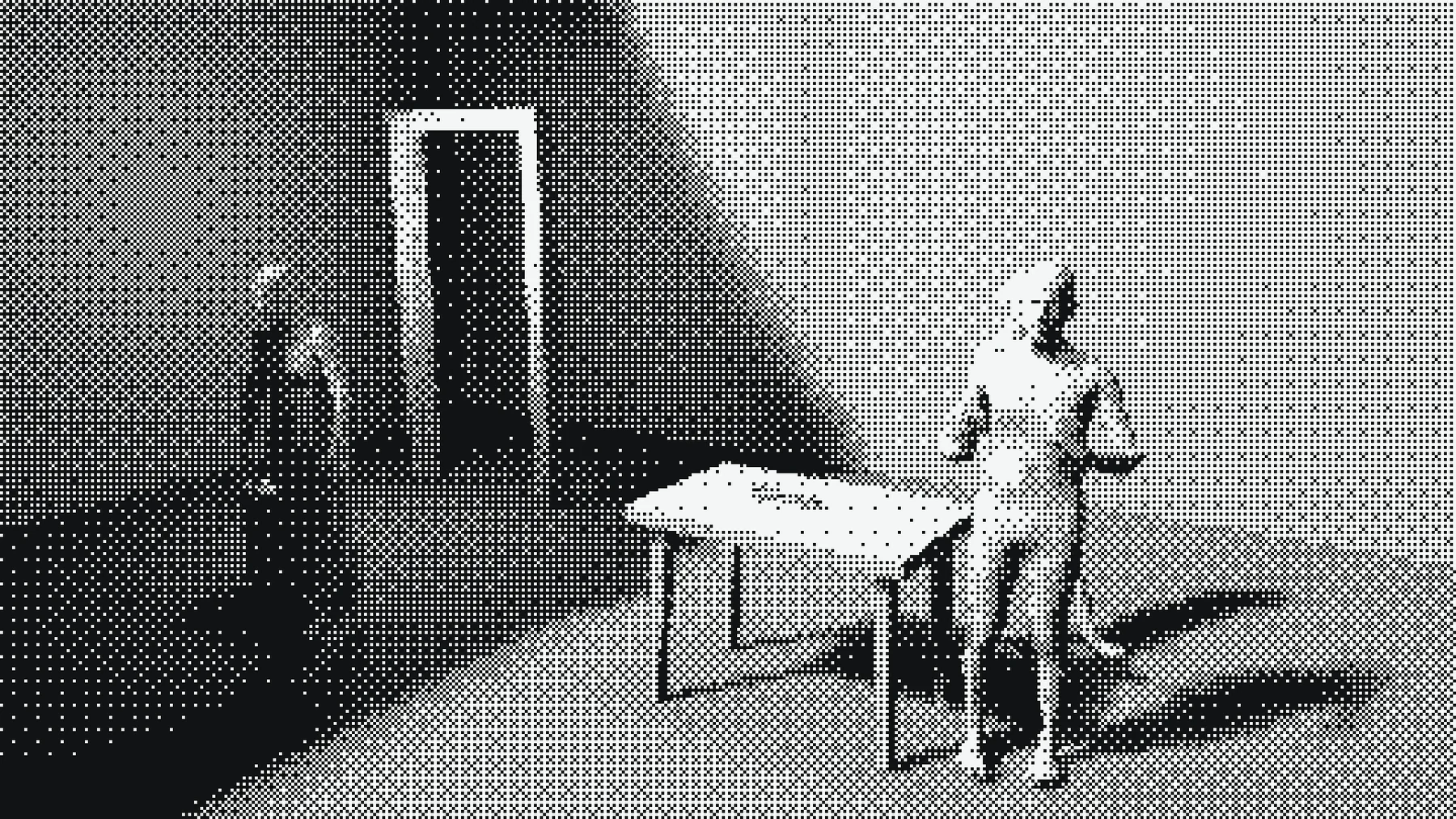
| the evening, bare clay | ||||
| the evening, re-dressed |
bare clay was refused as nudity; the scene was rendered again, dressed
4.A walkthrough: ten findings on forming the self
On 13 September I walked through the “forming the self” section and noted 10 findings, fixing 2 that day; that section later became act i’s single page and one minute. The one that mattered most is highlighted: the self it formed was never used at the end.
- A1highfixed · b7e3f00after choosing a reading, the text squeezes into a narrow column
- A2mediumfixed · b7e3f00after switching question, the prompt is off screen
- A3lowthe text box shows only 3 lines
- A4lowthe right column is empty or covers the legend
- B1highthe ending doesn’t pay off
- B2highyou can’t see why it thinks so
- B3mediumyou can’t see how the form leads to the negative
- B4mediumengineering terms on screen
- B5lowbig headings break words across lines
- B6to verifyit doesn’t say what the choices are for
The question I wrote from it (HMW draft no. 3): how might we give this version of the self a consequence the visitor can feel at the end, without overstating what the system can do?
04Technology · Experiment
2,000 runs of one scene: the mother’s first line never changes what the son does
Technology
1.The pipeline: made once in advance, then run for each visitor
From the page the visitor writes to the receipt they take home: the top row was made once in advance, the bottom row runs for each visitor. Only one step may use an online model, to find the events in the visitor’s words, and only with their consent.
in advance made once, the same for every visitor
each visit in the room, left to right
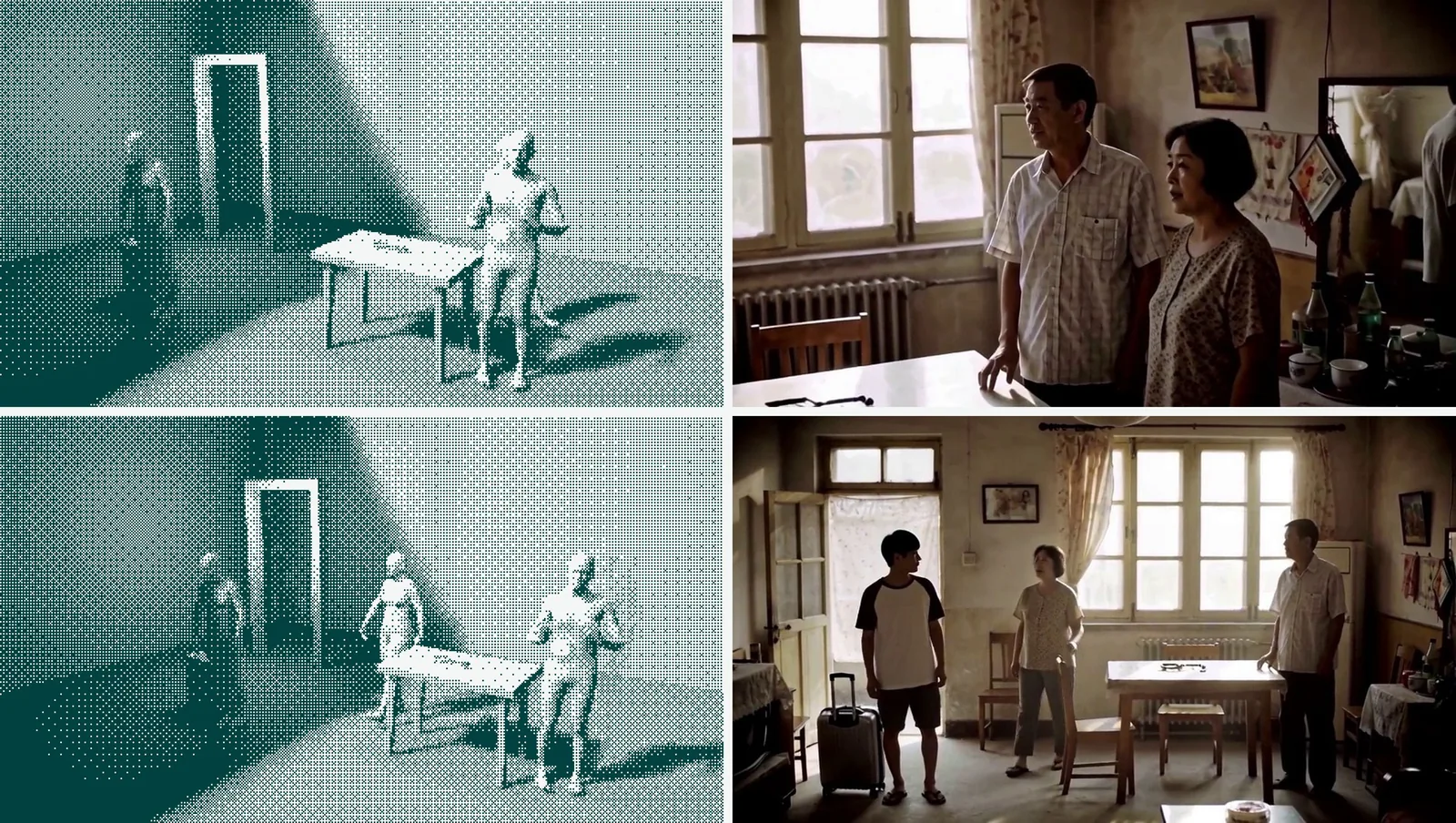
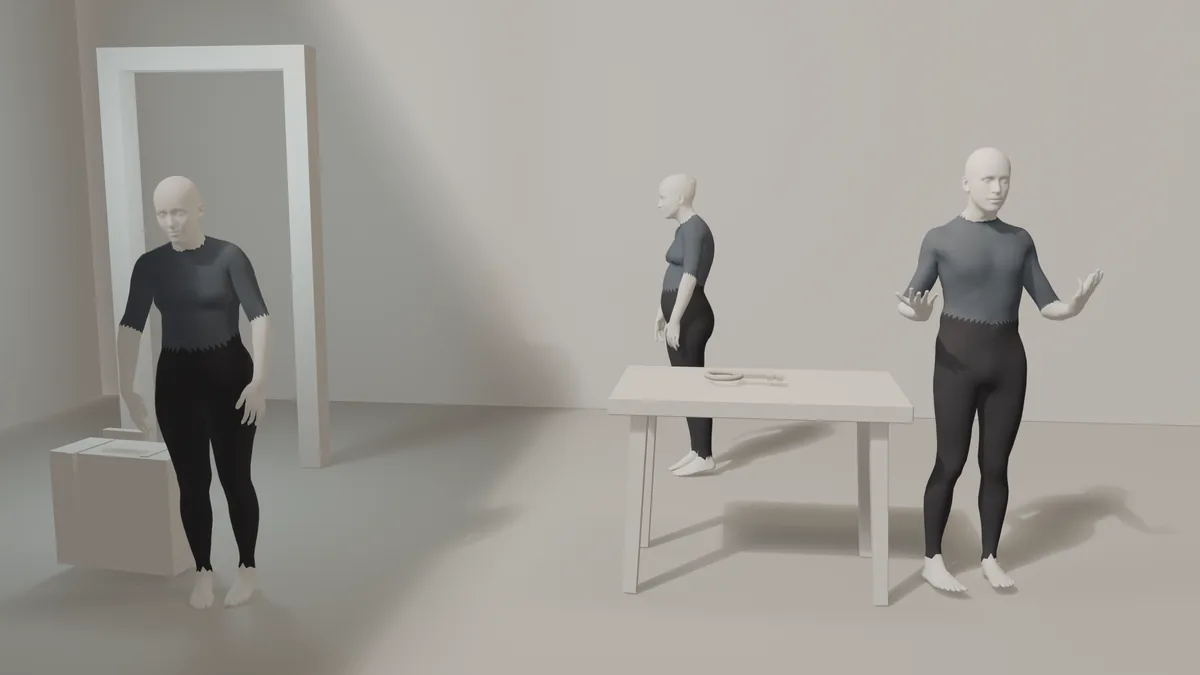 Blender 4.5the scene from the score · four cuts, 90 s
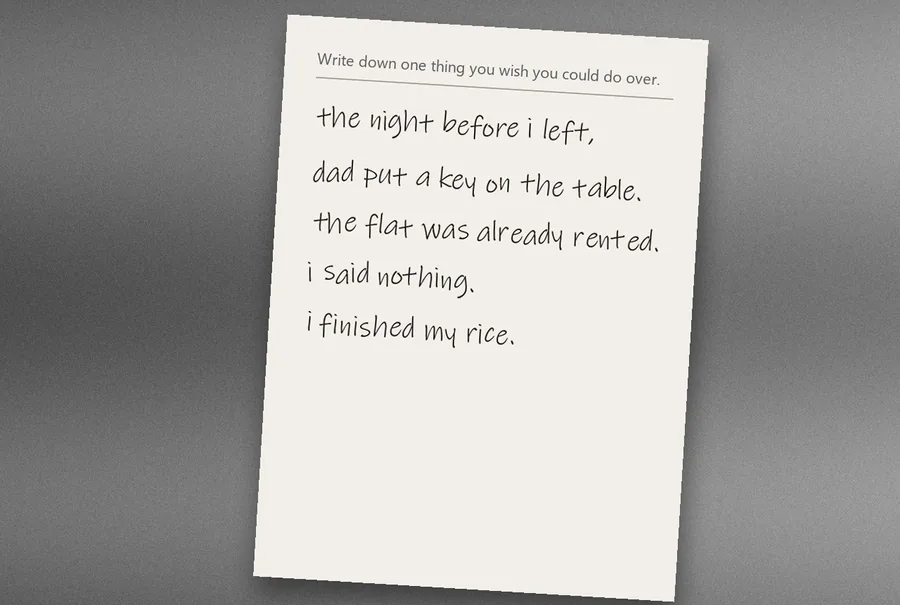 your pagewritten by hand · read oncecamera · OCRRapidOCR (PP-OCR) on the CPU · lines boxed and scored
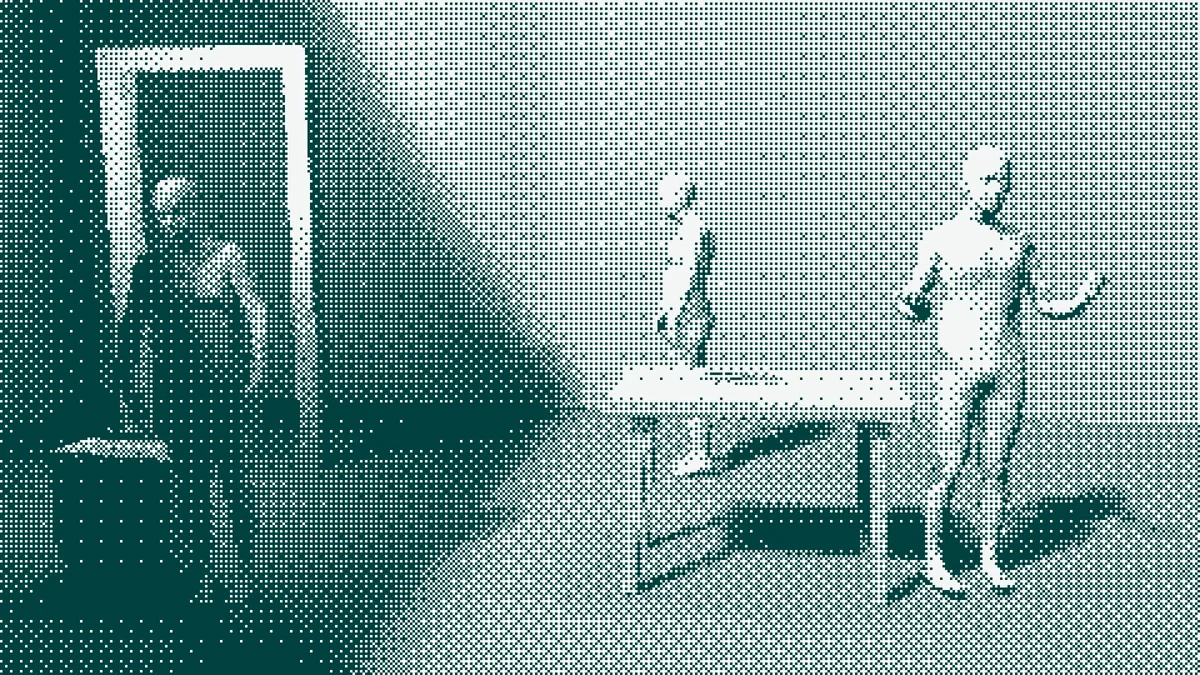 the scenerecorded cuts, drawn as dots in WebGL
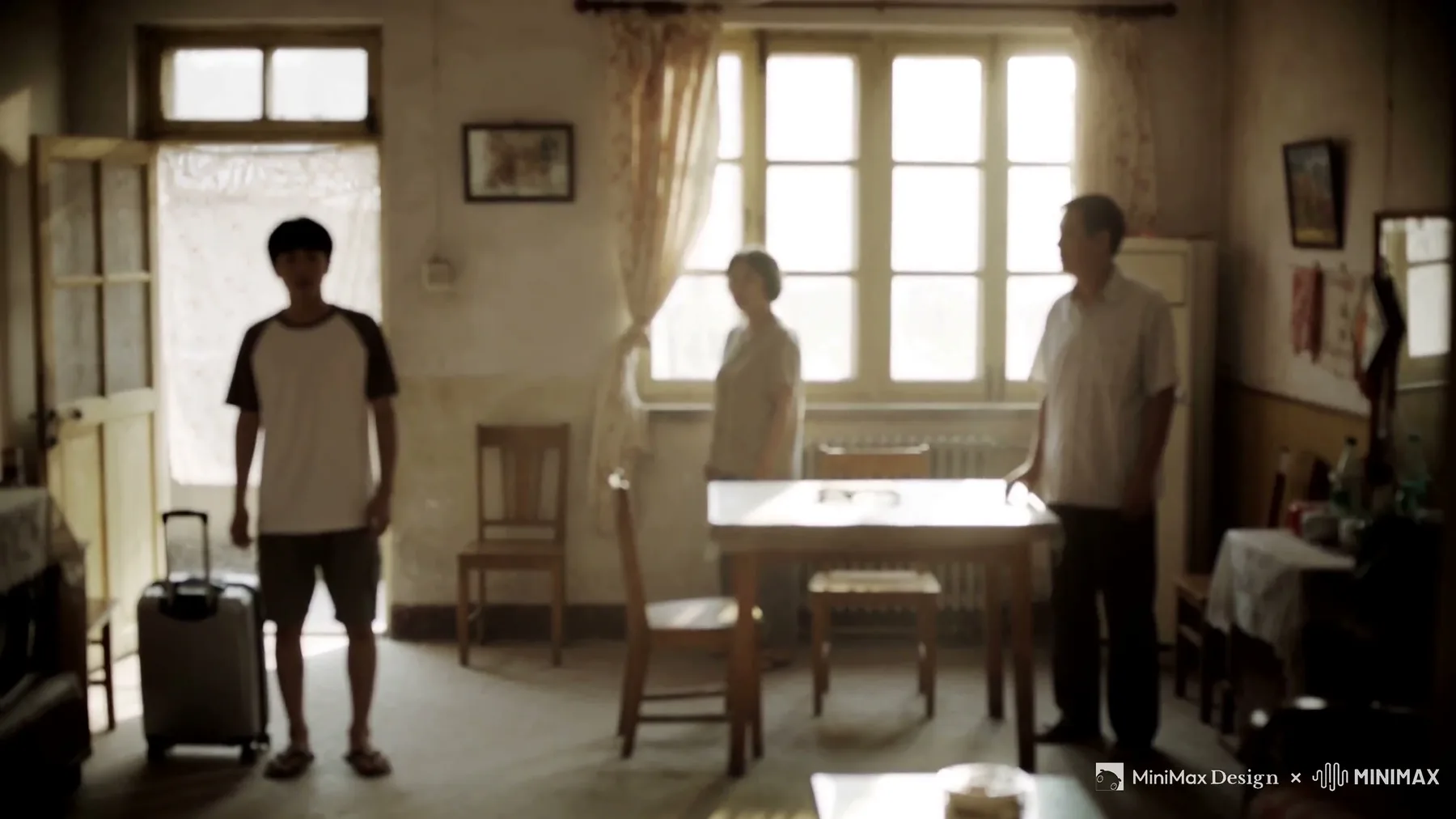
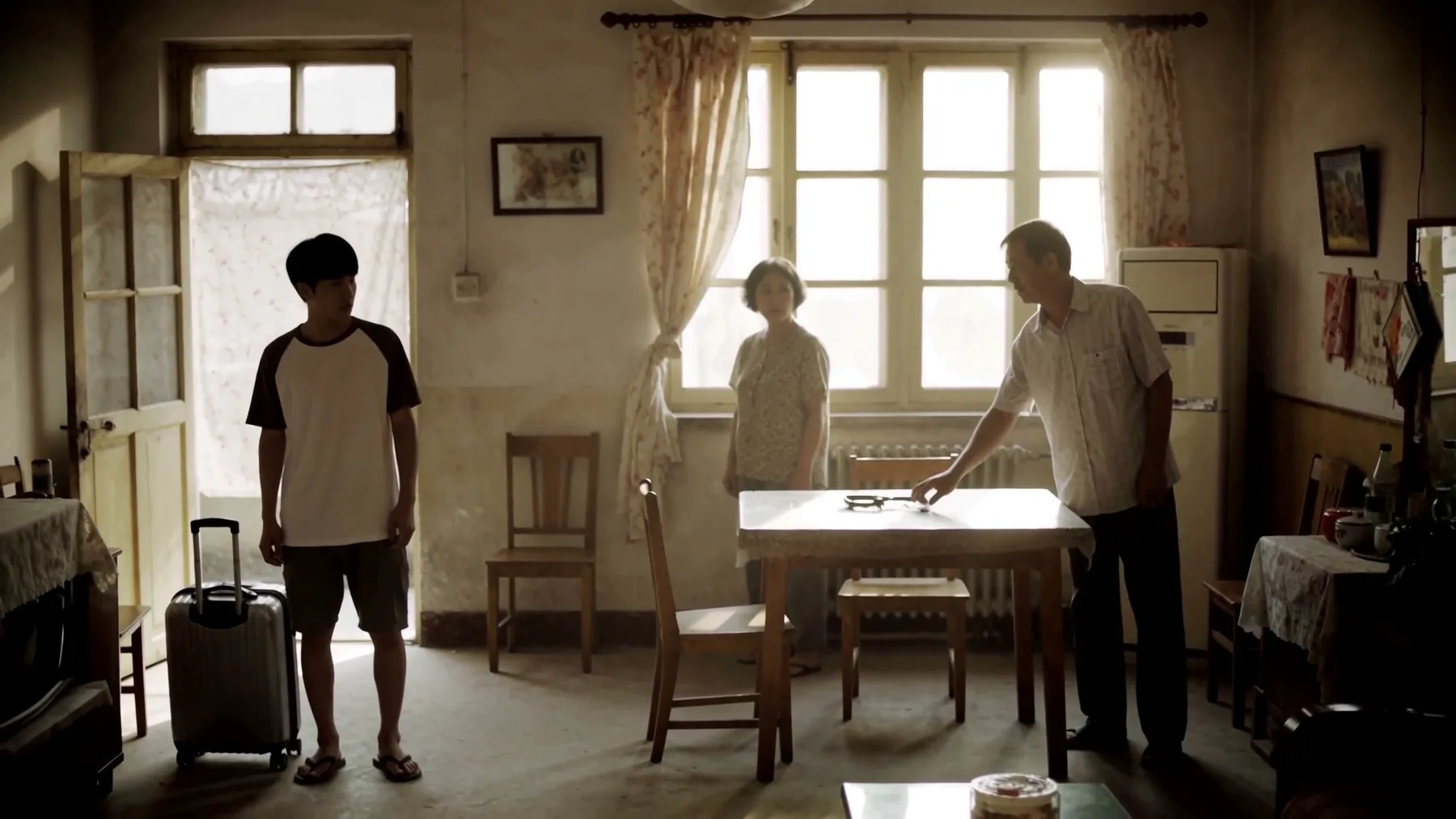
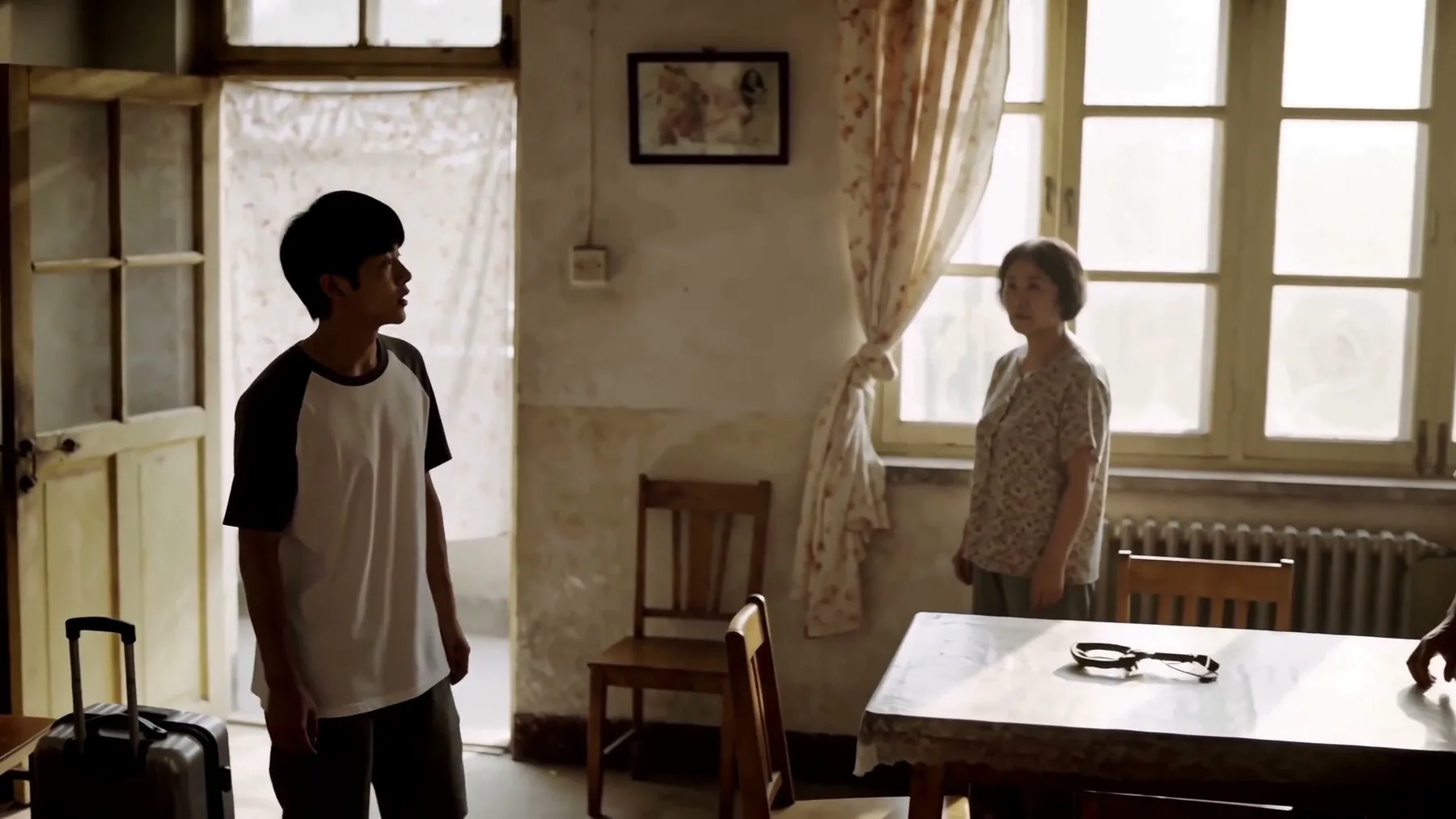
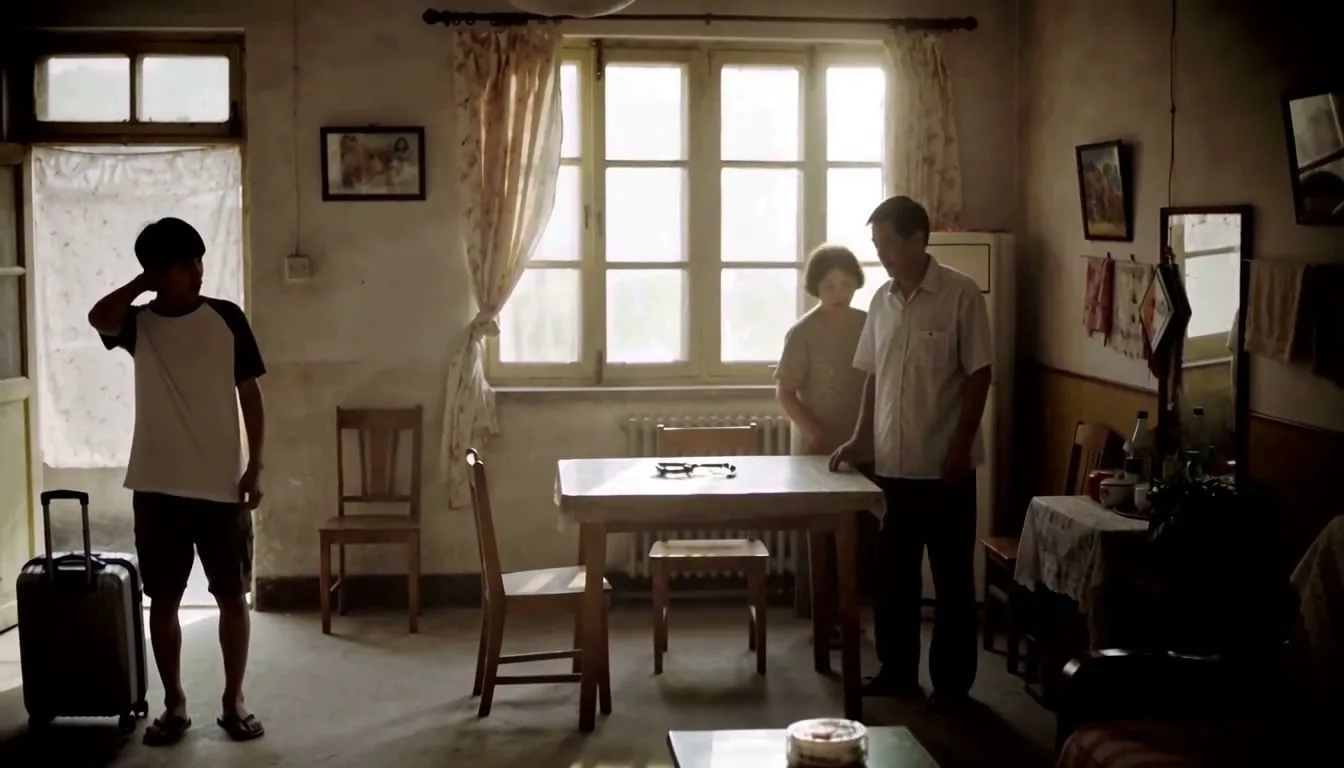
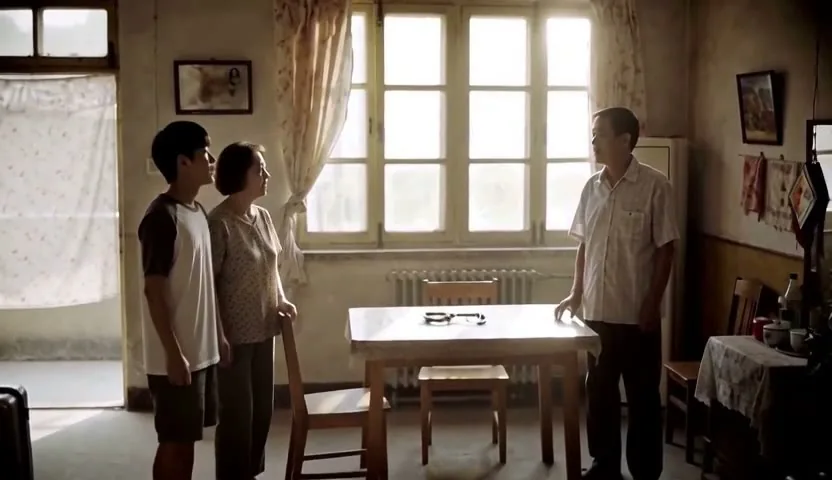
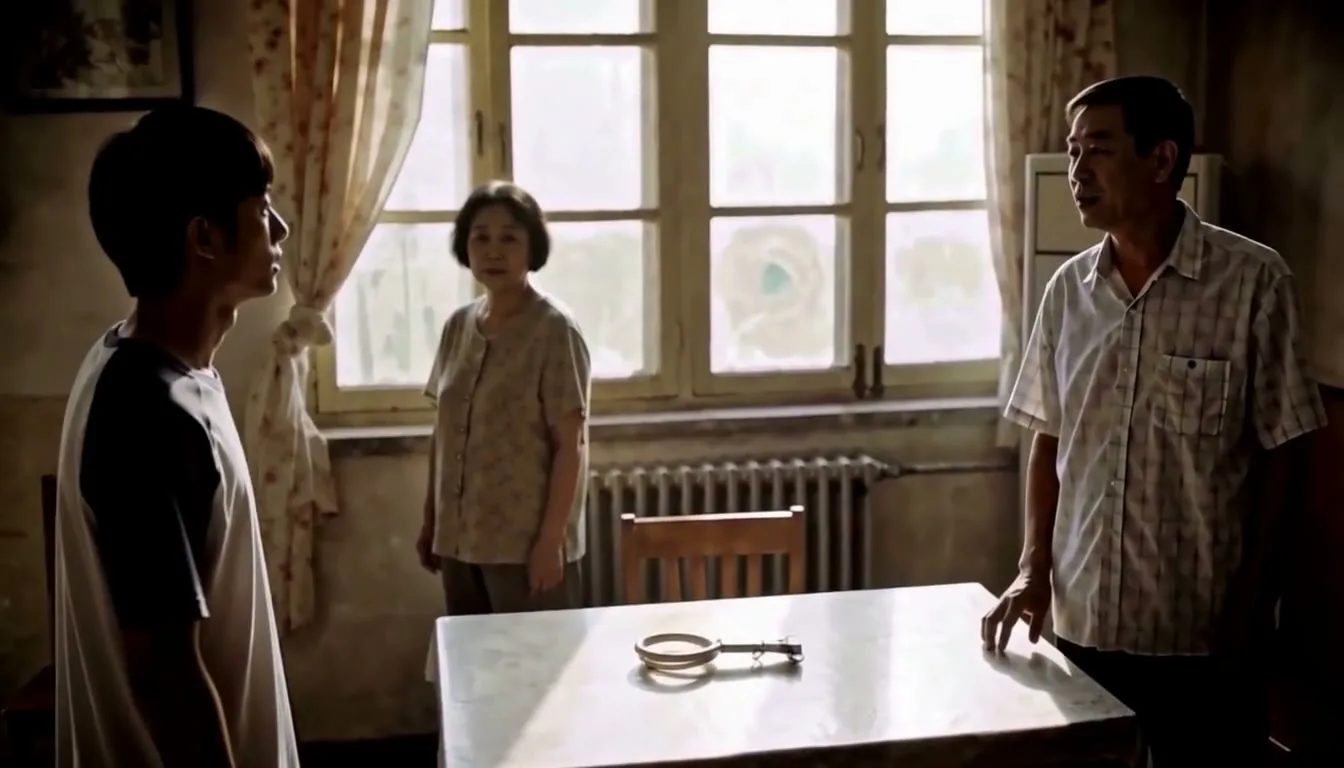
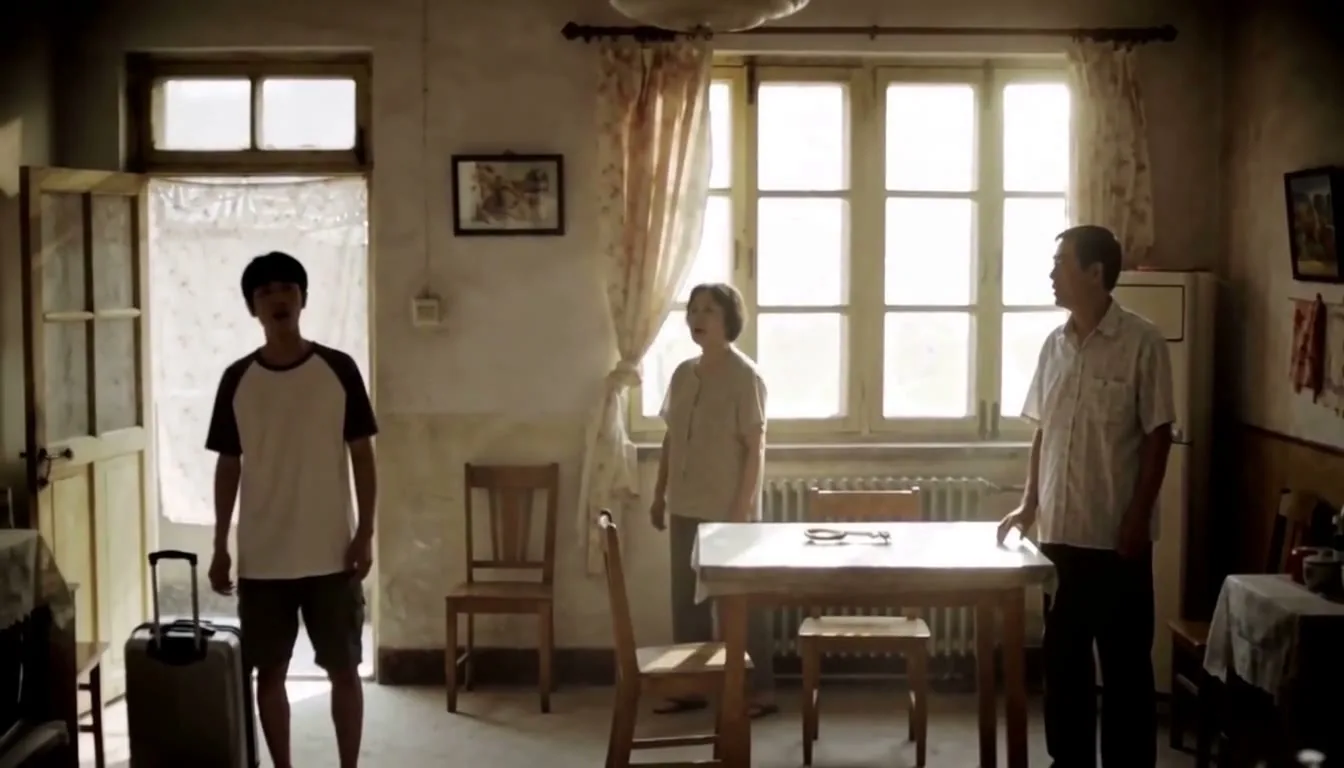
 the 2,000 runsact v · all of them replayed
 receiptthermal roll, 58 or 80 mm
Eleven steps across; swipe sideways to follow the visit.
ink: what people do or write · highlighted: the visitor’s own words · blue: the machine · blue ground: the one step that can go online · dashed: destroyed · everything else runs on this computer
# core/probability_theater · senses/server.py, engines.py · participant/src · scripts/blender · portfolio/seedance · tests: 75 files
Experiment
2.This evening was rehearsed 2,000 times
Before any visitor arrives, the model has rehearsed the evening 2,000 times: 1,000 pairs, each pair run twice with the same random numbers, changing only the mother’s first line.
This is the third part of the design goal (G3): letting people see the many possibilities rehearsed from data.
In the 1,000 pairs the son does the same at every step, and the ending differs in only 33. I designed the son not to be swayed by this line of his mother’s: there are many possibilities, and most of them end in the same place.
# trace_index_v1.json · 2,000 entries · each move drawn at triadic_family_rehearsal.py:1501weights = [math.exp(scores[option.option_id]) for option in options]; total = sum(weights); cursor = draw * total
3.One evening, two first lines
Father rented a flat for me to stay in without asking me first. My luggage is already by the door.
- aHe spent two months on this flat. At least hear him out.他为这房子跑了两个月,你至少听他说完。she sides with the father · 549 of 1,000
- bGo on. Slowly. We’ll listen first.你说。慢一点,我们先听着。she keeps room for the son · 405 of 1,000
both branches end
- sonOkay. The key stays here for now.好。钥匙先放这儿。
- fatherI’ll cook. We’ll talk about the key tomorrow.饭我做。钥匙的事,明天再说。
Both recorded branches end on the same two lines. The mother’s first line is the one thing the visitor chooses; the shared start runs 24 s, each branch 30.5 s, the rewind 5 s.
05Result · Value · Reflection
“This time, there was no rehearsal.”
Result
1.The Tongji show, September 2026
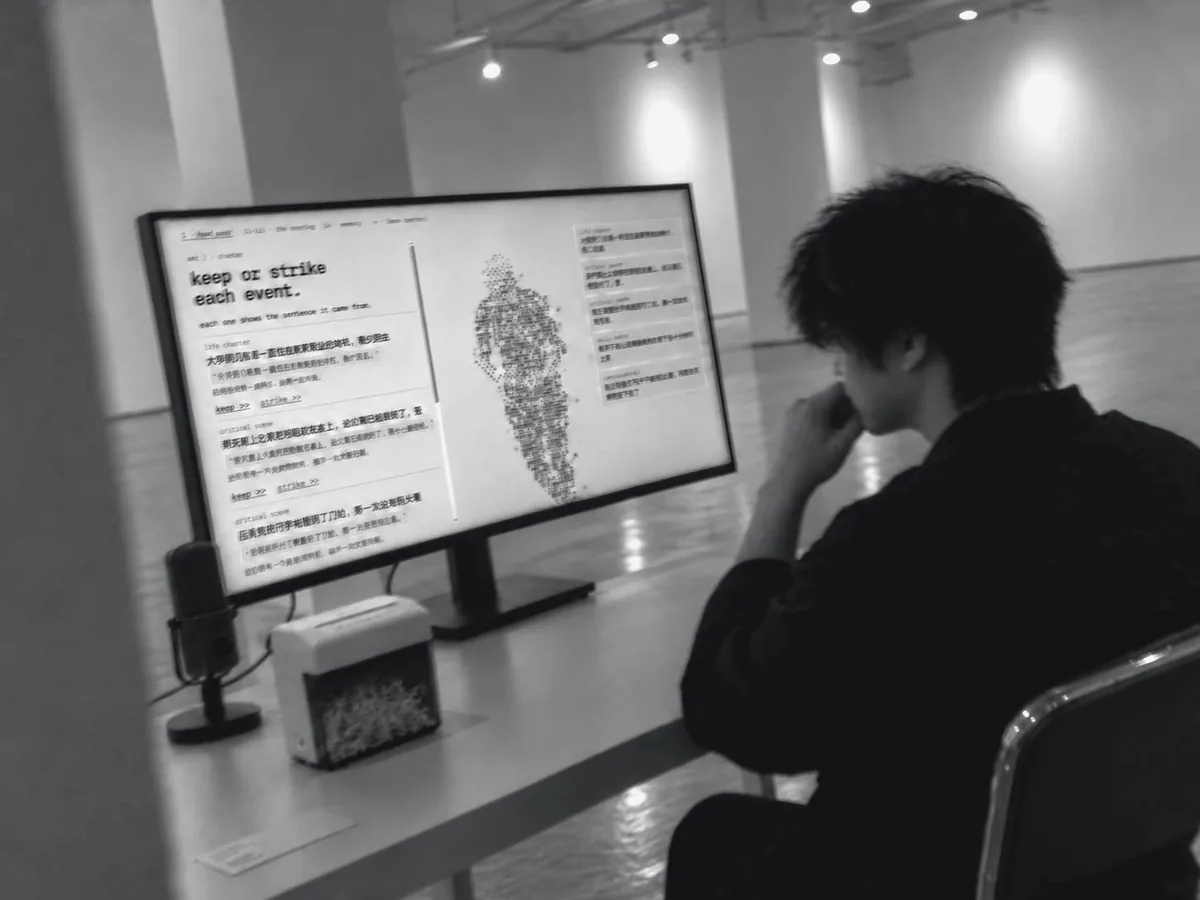
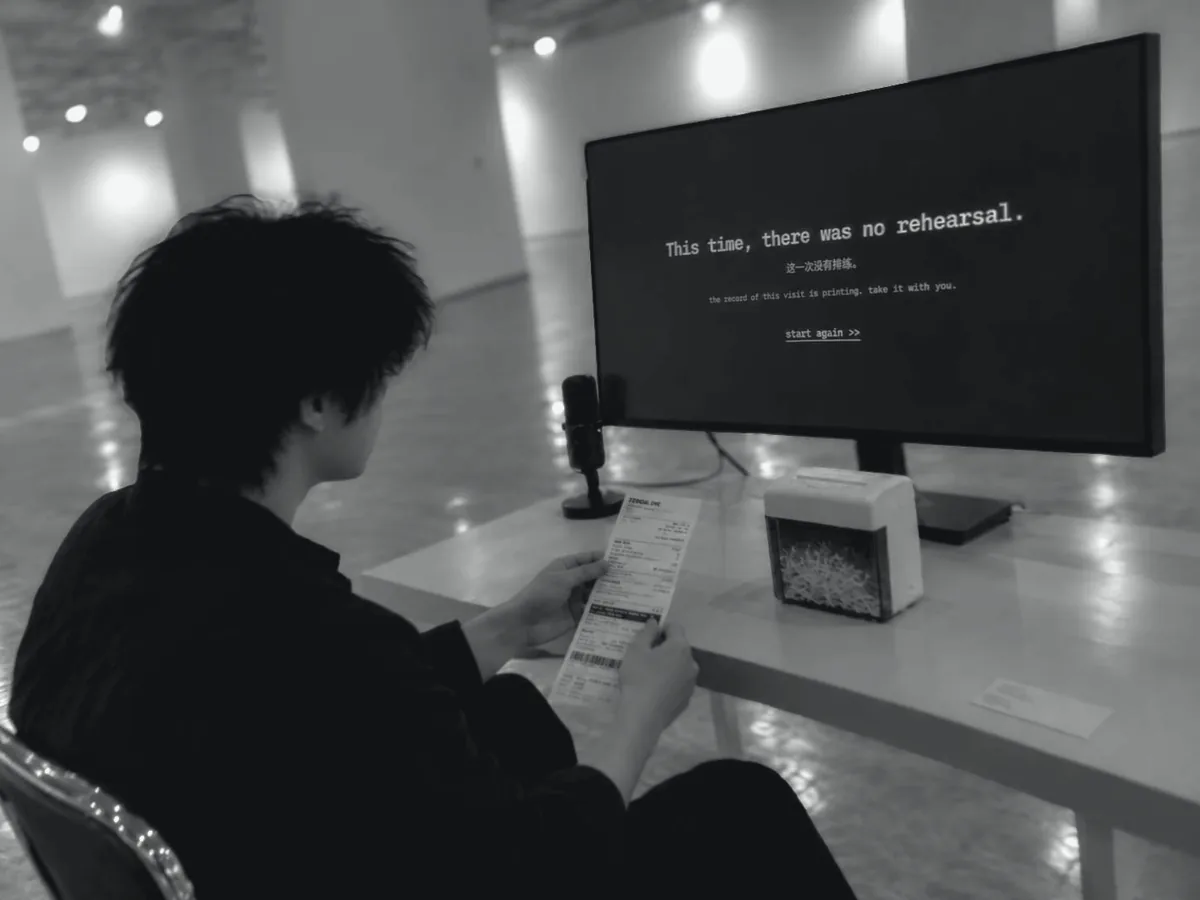
I set up a small show at the College of Design and Innovation, Tongji University, and invited friends to try it; a dozen or so visitors came. The photos show me trying it; a friend took them.
 DMS
 DMRS
The letters are the room’s: D screen, M microphone, R printer, S shredder.
2.What visitors took away
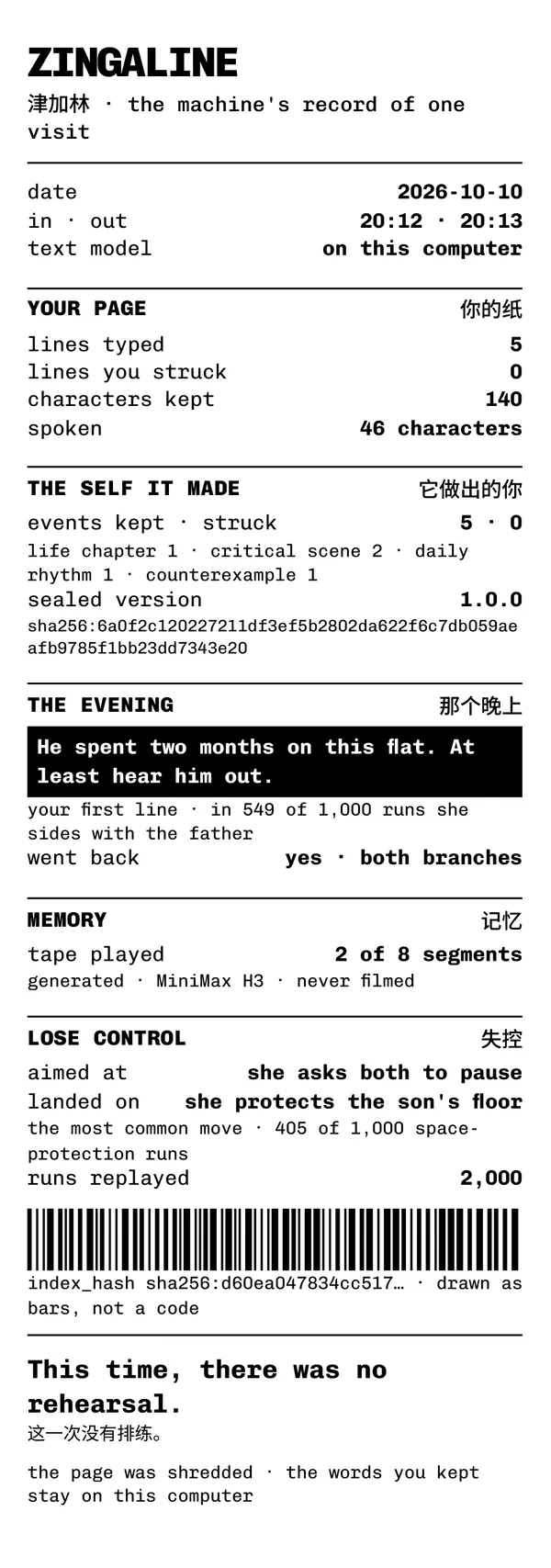
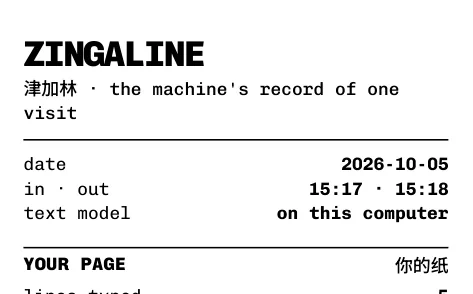
A thermal receipt: the machine’s record of this visit, in five parts, one for each act.
- YOUR PAGEhow many lines you wrote, struck out and kept, and how many characters
- THE SELF IT MADEhow many events you kept; the sealed version
- THE EVENINGhow often your first line came up in 1,000 runs; whether you went back
- MEMORYhow many clips played; generated, never filmed
- LOSE CONTROLwhat you wanted her to do, and what the machine chose for you; 2,000 runs replayed
At the foot it says: the page has been shredded; the words you left exist only on this computer.
Printed by the app, a run on 10 October 2026.
Value
3.What my friends said
In act iii I kept clicking “rehearse again”, thinking one more simulation might get both my mum and dad to really support my choice. But when the two thousand lines came flooding out behind the pointer in act v, I suddenly didn’t want to try any more. On the way out I sent my mum a WeChat message, without drafting what to say first. I felt I really have to live in the present. You could actually hear that the AI’s voice was a bit stiff, but that mechanical feel made it seem even more absurd to me.
第三幕我一直在点重新彩排一次,总觉得再模拟一次就能让爸爸妈妈都能真的支持我的选择。但看到第五幕指针两千条线全涌出来的时候,我突然不想试了。走的时候我给我妈发了条微信,也不想再打草稿想想要说啥了,感觉还是得活在当下啊。其实能听出 AI 的声音有点生硬,但那种机械感反而让我觉得更荒诞。
陈〇 · 19 September 2026 · sent on WeChat that evening
On the page I had written about a really bad fight with my family last month. Watching the son on the screen try every hard and soft thing to say for me, and still wreck everything, I suddenly felt it was a good thing that I left before that fight was over… at least in the end I could still send my mum a sorry.
我原本在纸上写的是上个月跟家里吵架吵得很凶的一件事。看屏幕里那个儿子替我把硬话、软话都试了一遍,最后还是搞砸了一切,我突然觉得当时最后没吵完我就走了是件好事……至少我最后还能给我妈发句对不起。
张〇〇 · 18 September 2026 · said at the door after the visit
These two remarks are the evidence for G4 in the visitors: realising that returning to the real matters most.
Reflection
4.After building the system
This was the first time I chained computer vision, voice cloning, a large language model and a 3D state machine into one complete narrative pipeline, trying to exhaust a family conversation by engineering. After running two thousand simulations in code, I came to see more and more that even if a large language model can work out the most probable line, the hesitation and soft-heartedness in our real relationships seem to be something an LLM really cannot understand: 664 runs ending in “nothing resolved” also showed me where algorithms reach their limit in complicated, intimate relationships. And the dozen or so visitors at the show rehearsed their own regrets through the dead end I wrote; as the one who built the system, I too finally saw the futility of rehearsal, and let go of my fixation on a “perfect life”. In mid-October, after I brought the equipment back from the show, my parents and I did talk about renting a place. It went worse than the model’s rehearsals, but somehow… not rehearsing was better.
这是我第一次把视觉识别、语音克隆、大语言模型和三维状态机串成一条完整的叙事管线,试图用工程的方法去穷举一场家庭对话。在代码里跑完两千次模拟后我愈发意识到,大语言模型即使能算出概率最高的台词,但我们真实关系里的犹豫与心软,LLM 好像真的没办法理解——664 次的结果是“什么都没解决”,也让我看到算法在面对复杂亲密关系时的边界。还有展览里的十几位访客借着我写的死胡同预演了各自的遗憾,作为搭建这套系统的人,最后也看清了排练的徒劳,放下了对“完美人生”的执念。十月中旬把设备从展厅拆回来后,我和爸妈还是聊了租房的事,过程比模型彩排出来的还要糟糕,但好像……没有排练更好。
References
- Fielder, N. (2022). The Rehearsal [TV series]. HBO.
- Malone, E. (2022, August 24). Nathan Fielder’s “The Rehearsal” resonates with autistic viewers. BuzzFeed News.
- Organization for Autism Research. (2025, June 4). Autistic viewers are talking about The Rehearsal.
- May, T. (2022, August 14). Nathan Fielder’s new comedy The Rehearsal will be familiar to anyone with autism. The Conversation.
- Bellinger, J. M., Perlman, E. H., et al. (2011). Social skills interventions for individuals with autism spectrum disorder. School Psychology Forum, 5(4), 141–159.
- Cartledge, G. (2007). Behavioral rehearsal. In Encyclopedia of Behavior Modification and Cognitive Behavior Therapy.
- 郝景芳 (2010).《看不见的星球》. Ken Liu 英译 (2013), Invisible Planets. Lightspeed.
- World Health Organization. (2025, June 30). Social connection linked to improved health and reduced risk of early death [News release].
- 中国青年报社社会调查中心、问卷网(2023). 最新一项民调发现 64.2% 受访青年感觉自己存在社交卡顿. 中新网, 2023-05-05.
- 中新社(2026). 东西问|项飙:年轻人如何找回真实的生活?2026-07-14.
- Fang, C. M., Liu, A. R., Danry, V., et al. (2025). How AI and human behaviors shape psychosocial effects of extended chatbot use: A longitudinal randomized controlled study. arXiv:2503.17473.
- Turkle, S. (2011). Alone Together: Why We Expect More from Technology and Less from Each Other. Basic Books.
- The six books: Arendt 1958; Bergson 1889; Rosa 2018; Han 2014; Baudrillard 1981; Dunne & Raby 2013.
- The figures: Park et al. 2024; Common Sense Media 2025; Pew Research Center 2026; Elon University Poll 2026; MIT Technology Review 2024; TechCrunch 2026.
Details
- Title
- Zingaline, 津加林. An installation for one visitor at a time, and the software, stage and film behind it.
- Medium
- An installation (a desk, a camera, a shredder, a microphone, a screen, a printer) · a web app in five acts · a Blender stage · a generated home video · an introduction film
- Data
- 19 people asked before making it · 2,000 runs of one scene, 1,000 paired seeds · 12 generated clips, 122 s
- Skills
- Speculative design · interaction design · writing · simulation · 3D staging · film
- Tools
- Python · TypeScript, WebGL2 · Blender 4.5 · Godot 4.7, for checks · RapidOCR · faster-whisper · DeepSeek V4 · MiniMax H3
Runs: trace_index_v1.json, the same 2,000 runs as records_v1.json; a pair is one run made twice with the same random numbers, once with each of the mother’s two first lines. The home video: generated, never filmed. Survey: my questionnaire, n = 19, people I know, self-report; answers translated by me. Figures: sources under each and in the references. Jinjialin 津加林: Hao Jingfang 2010, tr. Ken Liu 2013, paraphrased. Pictures: the app’s own frames on a synthetic archive and the baked stage, redrawn in the sheets’ ink. The room: drawn as a plan, in line drawings. Photographs of the Tongji show: taken by a friend, in the sheets’ ink. The still from The Rehearsal: HBO. Decisions: my design notes as written then. The data drawings are the project’s own (v5_data_studies.py).