Feng Kaiqi Design and research

person — a border

Wings & Wires

A scrolling data essay. Migrating birds are tracked with precision; people who die crossing borders are often left as a blank. I set the two records side by side to see who decides what gets written down, and what is left empty.

Year
2026
Role
Individual project: research, data processing, design and code
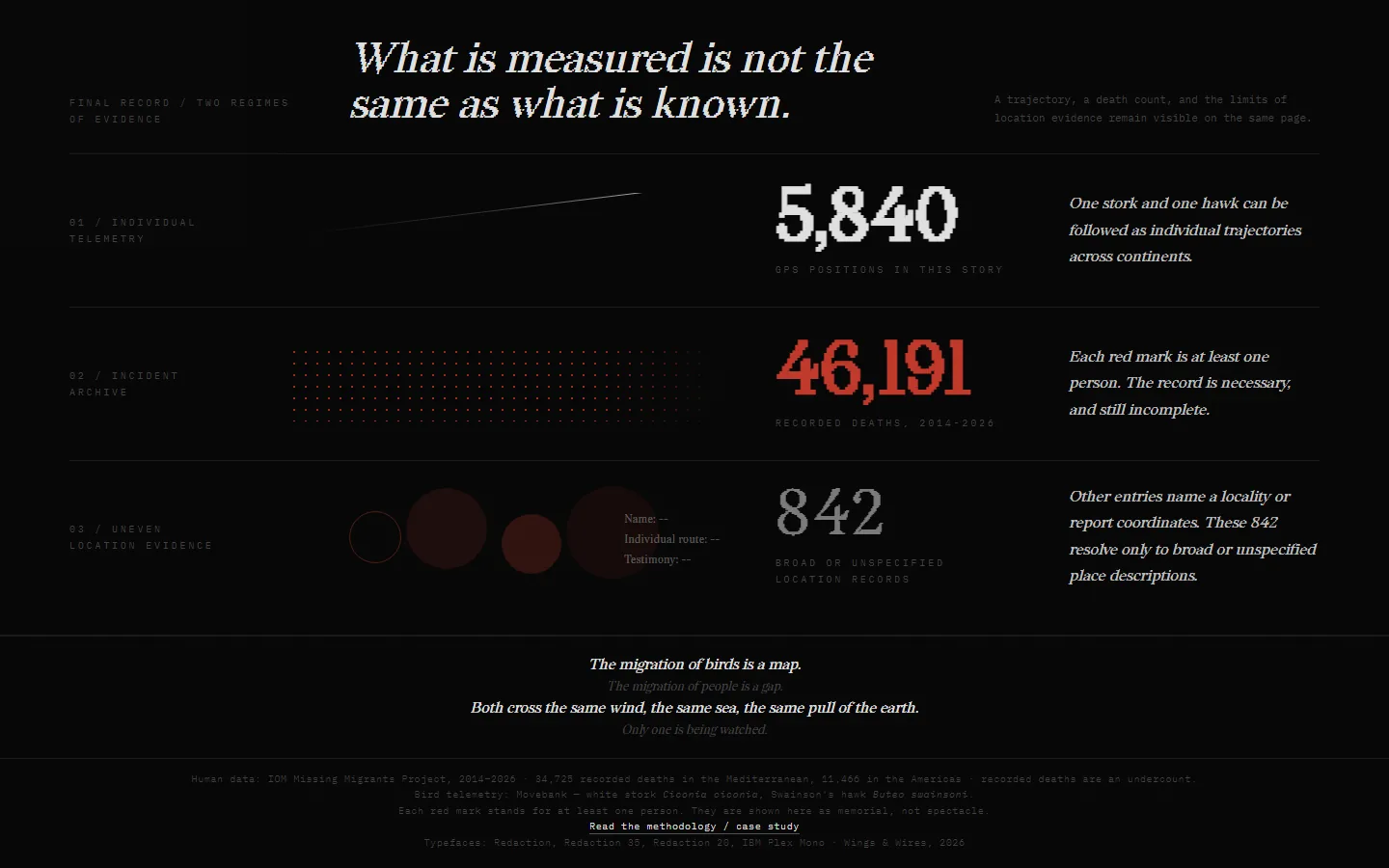
Ending: telemetry, recorded deaths and unresolved location evidence share one ledger.

01Question

What does it mean that birds are tracked with precision while people who die crossing borders are recorded as absences?

The essay sets GPS telemetry from migrating birds beside incident records from the IOM Missing Migrants Project. It does not equate birds and people. The contrast shows how institutions decide what can be followed, counted, or left incomplete.
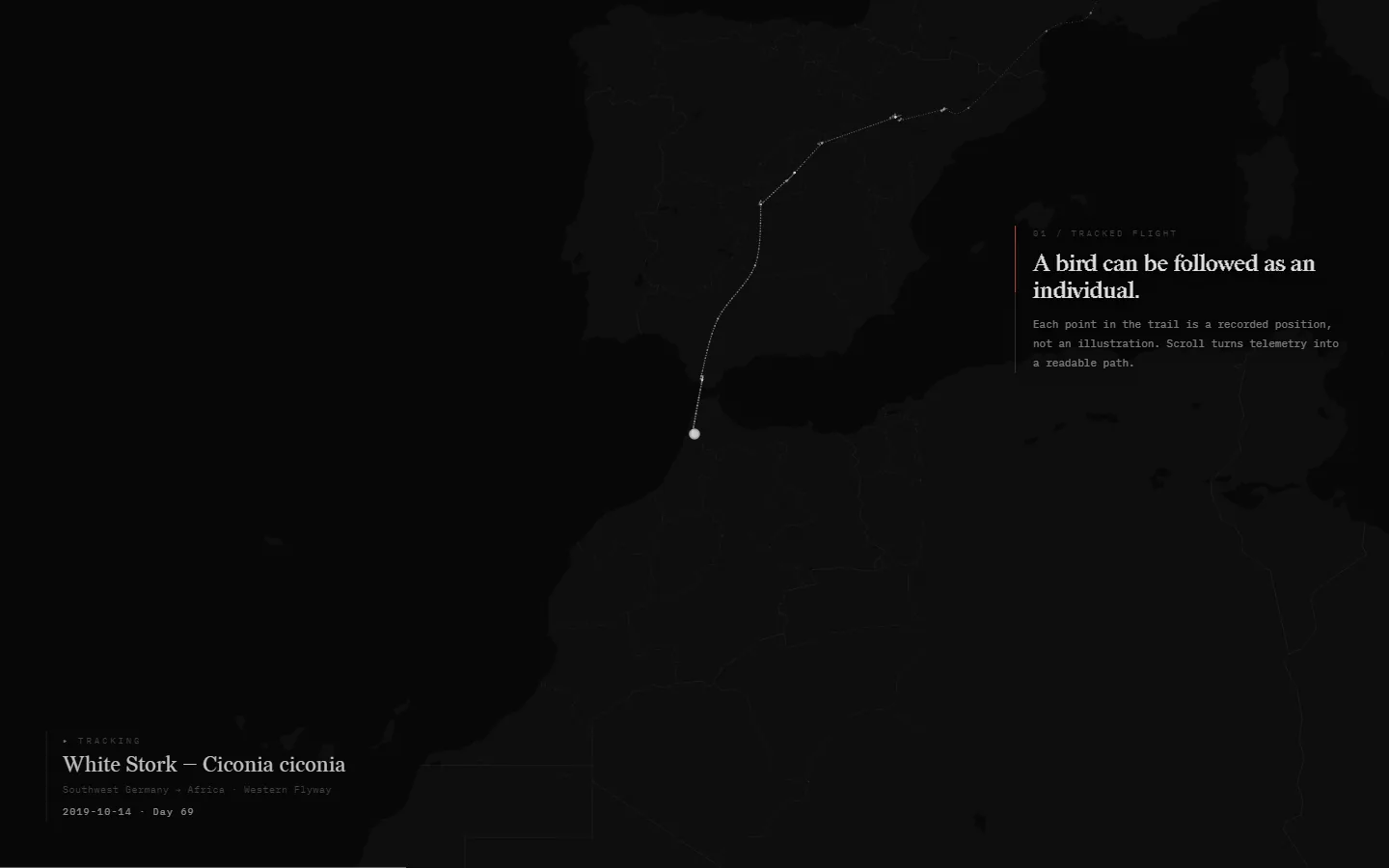
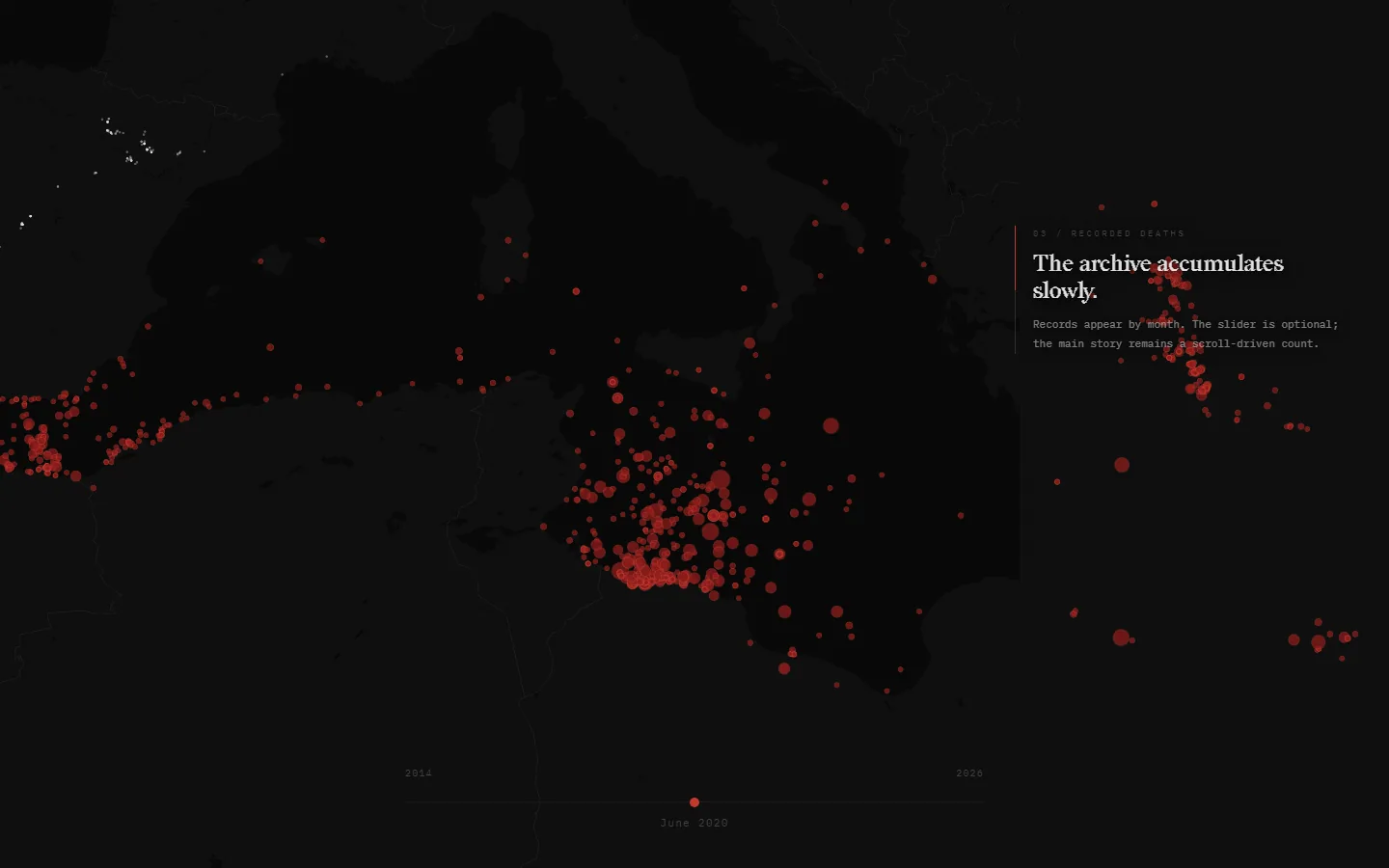
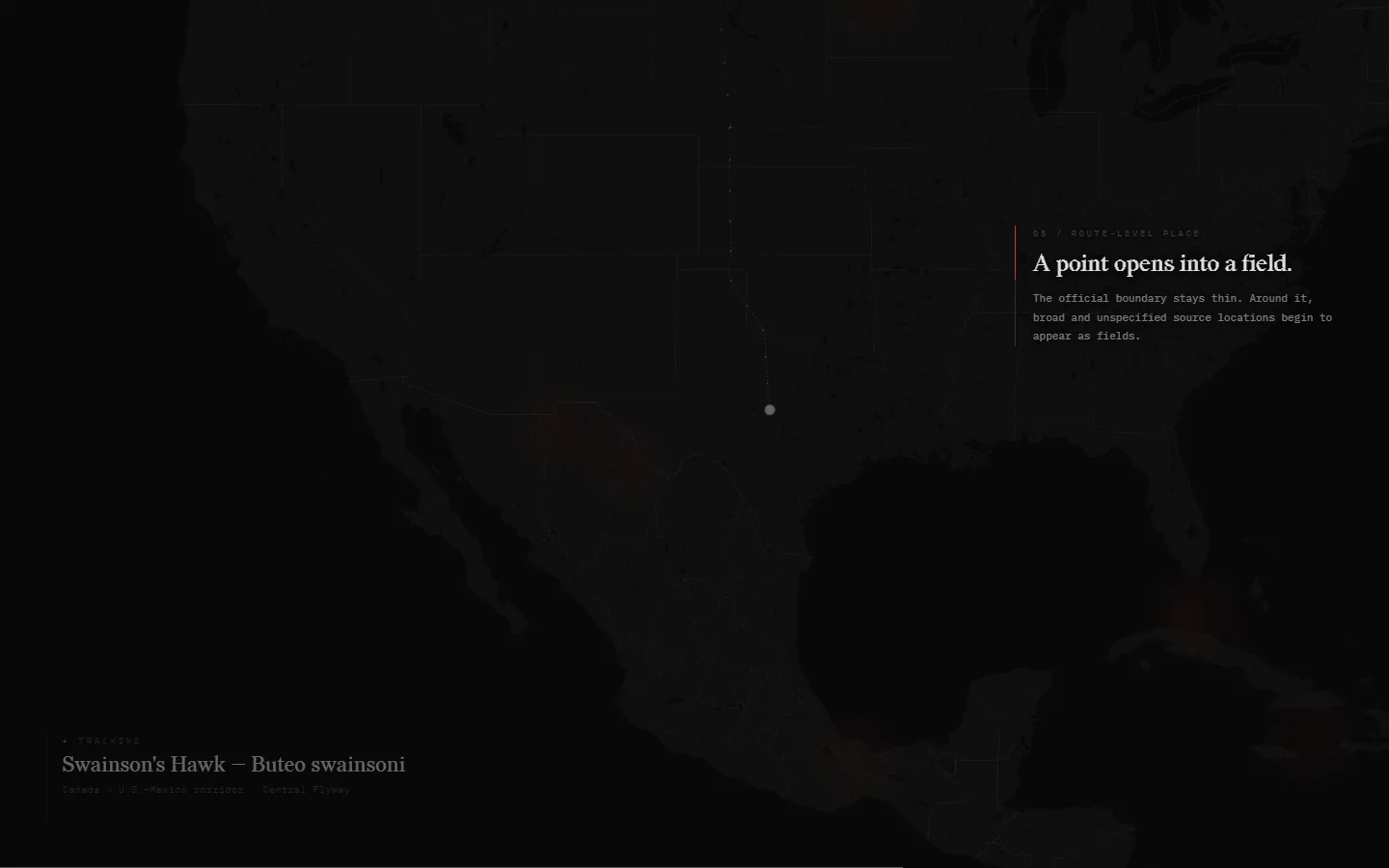
Chapter one: an individual trajectory remains spatially precise.

02Data

Two archives, two regimes of precision.

Movebank tracks follow a white stork across the Mediterranean and a Swainson's hawk across the Americas. The human records cover both regions from 2014 to 2026. In the Americas extract, 2,441 records give coordinates, 3,809 name a locality, 337 describe a route or region, and 513 leave the location unspecified.

Chapter one: tracked movement gives way to an incident archive.

03Make

Scroll is the sentence structure.

The essay runs in order: a tracked flight, a border, records accumulating, a memorial, a second region, a final ledger. Each step changes one visual idea. Trail dots mark only observed GPS fixes; positions drawn in between never use that mark.

Chapter two: the tracked point reaches the corridor before the evidence changes scale.

04Evidence

Uncertainty is drawn only where the source supports it.

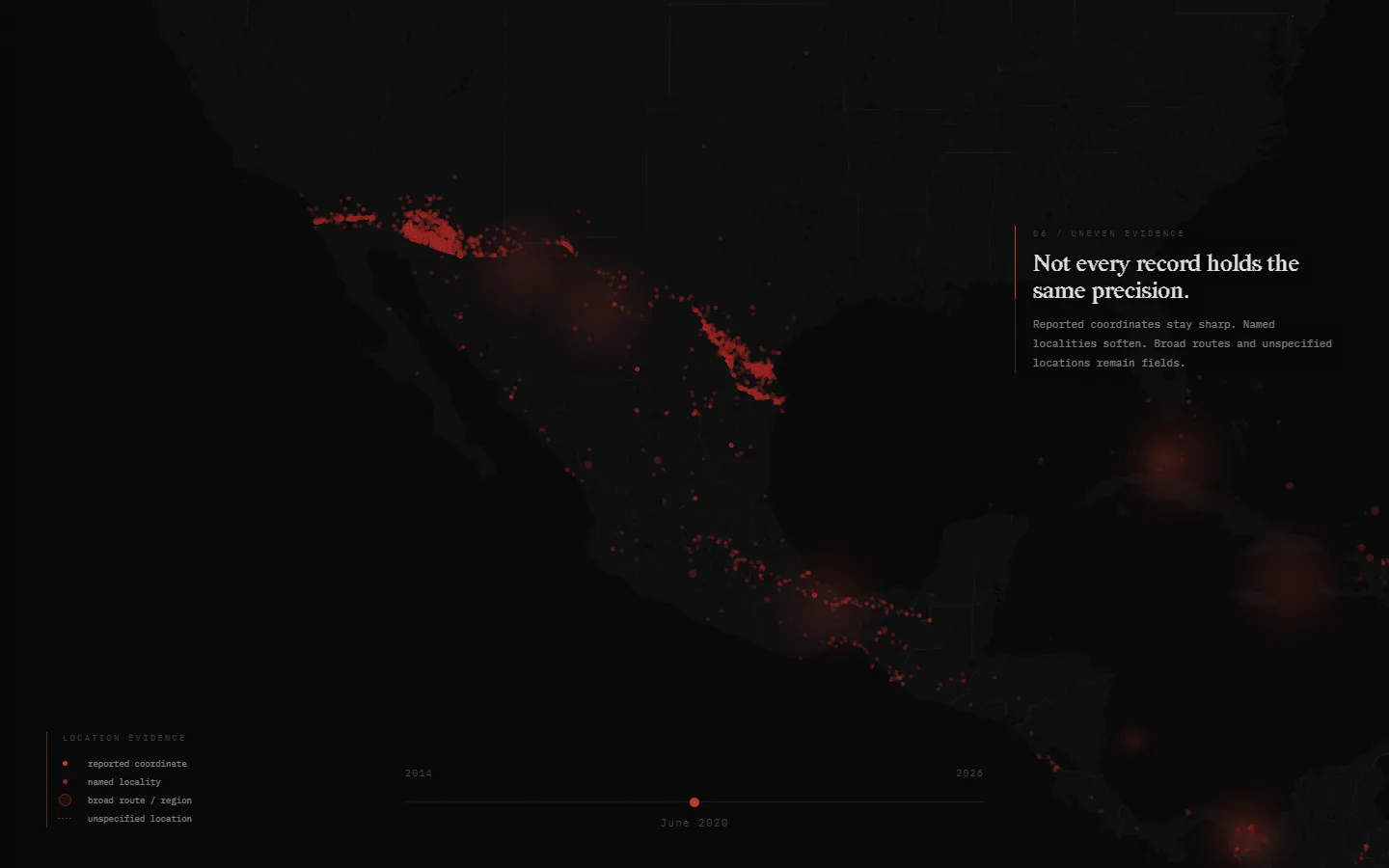
Reported coordinates stay as points. Named localities keep an anchor without claiming survey accuracy. Broad routes become fields instead of invented points, and unspecified records stay visibly unresolved. The four classes come from a versioned text rule, checked against a stratified sample.

Americas archive: point-like records and uncertainty fields remain distinct.

05Iteration

Several visually louder directions were removed.

An opening particle field was cut when it carried no narrative role. Generic cards became document bands, keys and ledgers. The memorial changed from a decorative wave into a chronological record wall.

06Outcome

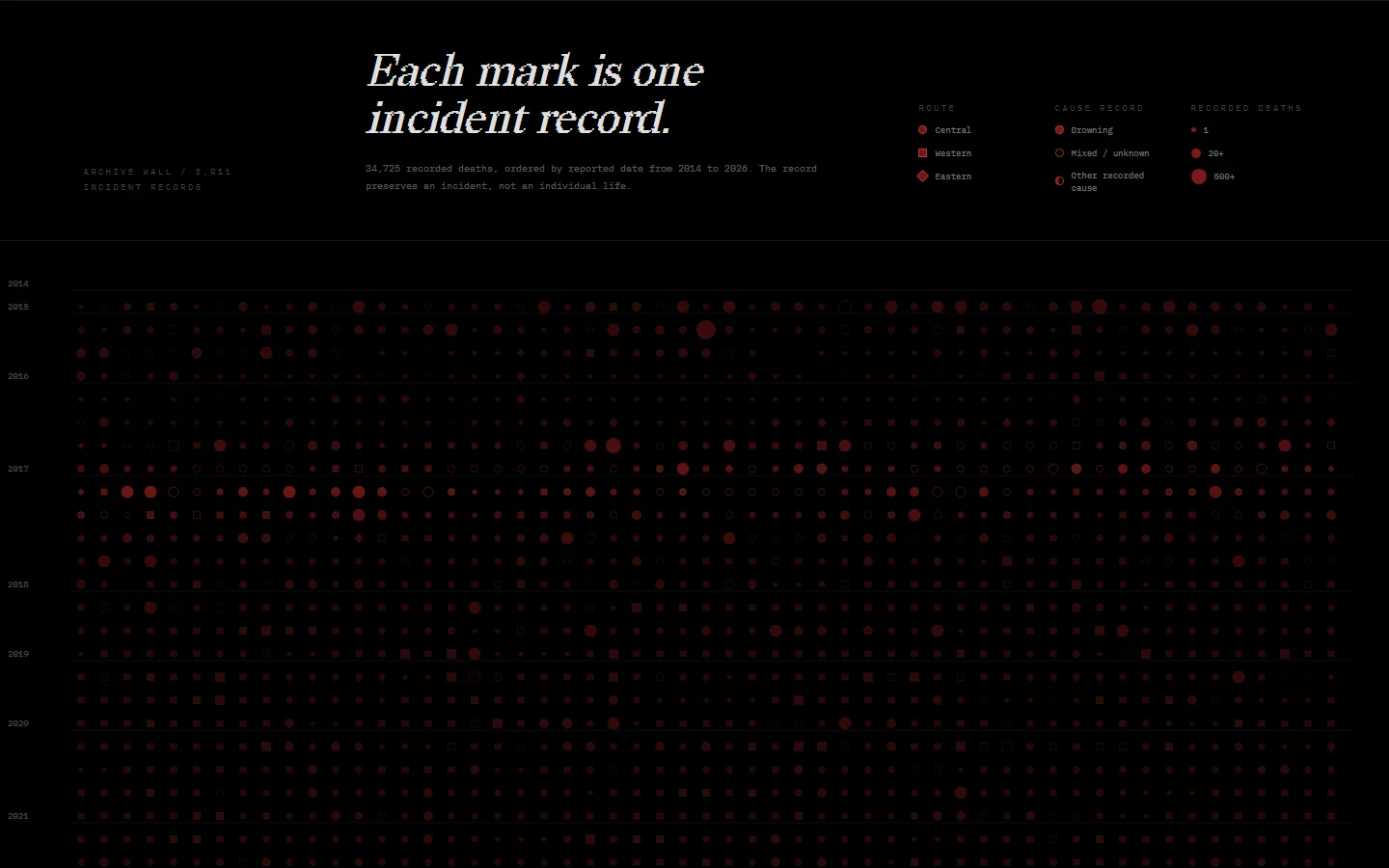
The archive wall keeps incidents without pretending they are lives restored.

The memorial orders 3,011 Mediterranean incident records from 2014 to 2026. Mark size encodes recorded deaths, shape the route, fill the cause. A record opens on hover, touch or keyboard. The ending holds telemetry, recorded deaths and unresolved locations on one ledger.

Memorial: 3,011 incidents ordered by reported date and encoded by route, cause and recorded deaths.

What this record can't say

AI use

Parts of the code were written with AI coding assistants, and AI assisted the data processing and analysis. The opening image of the essay is AI-generated and carries no data.

Details

Medium
Scroll-driven web essay
Data
Movebank bird telemetry · IOM Missing Migrants Project, 2014–2026
Tools
JavaScript (ES modules), Mapbox GL JS, D3, p5.js · Playwright checks

Human data: IOM Missing Migrants Project. Bird telemetry: Movebank. U.S.–Mexico boundary: 2025 U.S. Census TIGER/Line. Base maps © Mapbox © OpenStreetMap.